
For procurement managers and equipment owners in the mining sector, the hydraulic cylinder is not merely a consumable part; it is a critical point of failure. A failure in a dump truck hoist cylinder or an excavator arm cylinder does not just incur repair costs—it halts production.
Selecting the right components requires moving beyond basic dimensional matching. It demands a technical understanding of tribology, material science, and the specific capabilities of hydraulic cylinder manufacturers. This guide outlines the technical framework for vetting cylinders destined for high-abrasion, high-impact mining environments.
Defining “Mining-Grade” Performance
“Mining-grade” is not a formal ISO standard, but in engineering terms, it represents a specific set of design criteria that exceeds standard industrial specifications. A cylinder built for a factory floor cannot survive an open-pit mine.
The distinction lies in three factors:
- Shock Load Resistance: Mining equipment frequently experiences pressure spikes far exceeding the system’s nominal pressure. Cylinders must be designed with a safety factor of 4:1 or higher.
- Contamination Tolerance: The external environment consists of abrasive silica dust, coal fines, or corrosive salts.
- Side-Load Management: Uneven terrain causes significant radial forces on the piston rod, requiring reinforced guidance systems.
Key Technical Specifications for Harsh Environments
When reviewing technical drawings or proposals from manufacturers, prioritize the following three subsystems.
1. Rod Surface Technology: Beyond Hard Chrome
Standard hard chrome plating is often insufficient for modern mining applications due to its micro-cracking structure, which allows corrosion to penetrate to the substrate.
- HVOF Coatings: For corrosive environments, such as offshore mining or potash mines, specify HVOF coating hydraulic cylinder technologies. High Velocity Oxygen Fuel (HVOF) coatings provide higher density and bond strength than chrome, offering superior corrosion resistance.
- Ceramic Coatings: In environments with extreme particulate matter (e.g., iron ore or oil sands), a ceramic rod hydraulic cylinder for abrasive dust environment is often the superior choice. Ceramic coatings offer extreme hardness ratings preventing the scoring that typically destroys seals.
| Feature | Hard Chrome | HVOF | Ceramic |
| Micro-Hardness (HV) | 800 – 1000 | 1100 – 1400 | > 2000 |
| Corrosion Resistance | Moderate | Excellent | Extreme |
| Impact Resistance | Good | Very Good | Brittle (Care required) |
| Cost | Low | High | High |
2. Sealing Systems and Bearing Bands
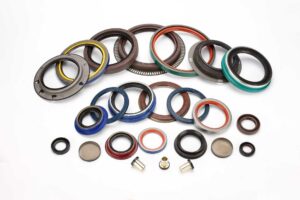
The seal configuration must match the climate. Standard nitrile (NBR) seals fail in the extreme cold of Siberian or Canadian mines, leading to immediate leakage upon startup.
- Low-Temperature Profiles: Ensure the manufacturer uses compounds engineered for -40°C to -50°C if operating in sub-zero zones.
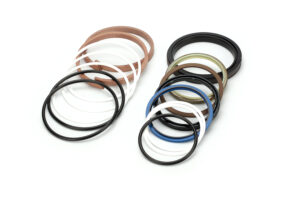
- Buffer Seals: A primary buffer seal is non-negotiable in mining. It absorbs pressure spikes before they reach the main rod seal, extending the lifespan of the sealing system.
- Guide Rings: Replace metal-on-metal contact with high-load composite bearing bands to better handle side loads and prevent cylinder scoring.
3. Cylinder Barrel and Welding Integrity
The yield strength of the barrel material determines the cylinder’s ability to withstand ballooning under pressure.
- Material: Look for ST52, E355, or 27SiMn steel grades as a baseline.
- Welding: Friction welding is preferred for rod-eye connections to ensure structural integrity under fatigue loading.
Vetting Hydraulic Cylinder Manufacturers
Finding a vendor is easy; finding a strategic partner requires strict vetting. The market is saturated with low-cost options that lack the engineering depth for mining applications.
Engineering Verification (FEA)
Do not accept a design based solely on “previous experience.” Reputable hydraulic cylinder manufacturers should provide Finite Element Analysis (FEA) reports upon request. These reports simulate stress distribution under maximum load and side-load conditions, proving the design is safe before metal is cut.
Testing Protocols
Ask specifically about their testing methodology. A static pressure test is insufficient.
- Cycle Testing: Does the manufacturer perform endurance testing?
- Contamination Control: What ISO cleanliness code (ISO 4406) do they guarantee for the oil inside the delivered cylinder?
Supply Chain and Lead Times
In the mining industry, asset availability is the primary KPI. A lower unit price is irrelevant if the lead time is erratic.
- Emergency Response: Does the supplier offer a custom hydraulic cylinder manufacturer fast delivery program for breakdown situations?
- Stocking Agreements: Are they willing to hold critical seal kits or semi-finished rods in stock for your specific fleet?
Common Procurement Mistakes
1. Ignoring the Repairability Factor Some cylinders are welded shut or designed with proprietary glands that cannot be removed without specialized tooling. Always specify a design that allows for field service or local remanufacturing. Bolted heads or threaded glands with standard spanner holes are preferred.
2. Undersizing the Rod To save weight or cost, buyers often accept standard rod diameters. In mining, rod buckling is a common failure mode. Always calculate the Euler buckling load limit based on the fully extended length and opt for the next size up in rod diameter for safety.
3. Focusing on Purchase Price vs. TCO A cylinder that costs 20% less but requires seal replacements every 2,000 hours costs significantly more in downtime and labor than a premium cylinder that lasts 8,000 hours. Calculate Total Cost of Ownership (TCO) based on maintenance intervals.
FAQ: Quick Technical Answers
What is the best cylinder coating for saltwater environments? HVOF (High Velocity Oxygen Fuel) or Nickel-Chrome plating are the most effective solutions for saltwater corrosion resistance, significantly outperforming standard hard chrome.
How do I prevent hydraulic cylinders from drifting? Drift is usually caused by internal leakage across the piston seal or the control valve. For the cylinder specifically, ensure the use of zero-leakage piston seals (like cast iron rings or high-durometer PU caps) and verify the barrel honing quality (Ra < 0.4 µm).
Why do cylinder rods bend in mining equipment? Rod bending occurs when the compressive load exceeds the column strength of the rod (Buckling), or when excessive side-loads are applied. This is often due to operator error or undersized rod diameters relative to the stroke length.
What is the standard warranty for mining hydraulic cylinders? While standard industrial warranties are 12 months, premium mining-grade cylinders often carry warranties of 3,000 to 5,000 working hours, provided maintenance schedules are followed.
The Procurement Checklist
Before finalizing a purchase order for mining hydraulic cylinders, confirm the following:
- [ ] Duty Cycle Analysis: Has the manufacturer reviewed the pressure spikes and cycle frequency?
- [ ] Environmental Match: Are seals and coatings rated for the specific temperature and abrasion level of the site?
- [ ] Safety Factor: Is the design safety factor at least 4:1?
- [ ] Documentation: Will the shipment include material certificates, pressure test reports, and an operation manual?
- [ ] Interchangeability: Are the mounting dimensions (pin size, center-to-center length) confirmed to match the existing equipment exactly?
- [ ] After-Sales: Is there a confirmed lead time for replacement seal kits?