The Komatsu PC200 and PC300 platforms are two of the most produced medium-class hydraulic excavators in the world. Combined, they account for tens of thousands of working machines across North America, Europe, the Middle East, Southeast Asia, and Latin America — most of them outside their original Komatsu warranty window, and most of them on at least their second set of hydraulic cylinders. That installed base creates one of the largest aftermarket replacement opportunities in the excavator parts industry, and one of the most confusing to navigate.
Confusing because Komatsu doesn’t make cylinder selection simple. A “PC200 boom cylinder” isn’t a single part. It’s roughly nine different cylinders depending on which generation of the machine (–3, –5, –6, –7, –8), which serial number range (200001-up, A86001-up, C70001-up, etc.), which boom configuration (standard, long-front, super-long-front), and which production variant. Order the wrong one and the mounting pins won’t line up, the port locations are mirrored, or the stroke comes up short. This Komatsu PC200/PC300 hydraulic cylinder replacement guide breaks down what each generation actually uses, how to verify part numbers correctly, and what an OEM-grade aftermarket sourcing process should look like.
Komatsu PC200 Hydraulic Cylinder Specifications by Generation
The PC200 platform has been in continuous production since the 1970s, with major generation revisions designated by the suffix after the dash (PC200-3 through PC200-8 in the modern era, plus PC200-10 / PC200-11 in current production). Cylinder dimensions evolved alongside the machine, with generational shifts in bore and rod diameter that change everything about replacement sourcing.
Confirmed specifications based on Komatsu cylinder part number references and aftermarket seal kit cross-references:
| Generation | Boom Cylinder | Arm (Stick) Cylinder | Bucket Cylinder | Common Cylinder P/N (Boom) |
|---|---|---|---|---|
| PC200-3 / PC200LC-3 | 120 mm bore × 85 mm rod | 130 mm bore × 90 mm rod | (varies) | 206-63-59400 |
| PC200-5 / PC200LC-5 | 130 mm bore × 90 mm rod | 130 mm bore × 90 mm rod | (varies) | 707-99-46600 series |
| PC200-6 / PC200LC-6 | 130 mm bore × 90 mm rod | 130 mm bore × 90 mm rod | (varies) | 707-99-46600 series |
| PC200-7 / PC200LC-7 | 130 mm bore × 90 mm rod | 130 mm bore × 90 mm rod | (varies) | 707-01-0A940 (after C70001-up / 200001-up) |
| PC200-8 / PC200LC-8 | 130 mm bore × 90 mm rod | 130 mm bore × 90 mm rod | (varies) | 707-01-0H580 |
Two patterns matter here. First, the PC200-3 used a smaller 120 mm bore boom cylinder — that earlier generation isn’t dimensionally interchangeable with anything from PC200-5 forward. Second, from PC200-5 through PC200-8, the boom cylinder geometry standardized at 130 mm × 90 mm but the part numbers changed across generations and within serial number ranges. A 707-01-0A940 boom cylinder for a PC200LC-7 serial A86001-up is dimensionally similar to a PC200LC-7 serial 200001-up — but they’re documented under different part numbers, and the safe assumption is always to confirm against the machine’s exact serial.
The 707-XX-XXXXX part number prefix is Komatsu’s standard hydraulic component identifier. The middle two digits indicate component category (01 for assembled cylinders, 98/99 for seal kits), and the last five digits identify the specific part. Knowing this format makes verification easier when ordering — anything that doesn’t follow this structure isn’t a Komatsu OEM number.
System working pressure on PC200-7 and PC200-8 generations sits at 34.3 MPa (~4,978 PSI) for the implement circuit, with hydraulic flow of approximately 220 L/min on the PC200-7 platform. Cylinder design specification is 35 MPa working / 52.5 MPa proof, matching the broader Komatsu construction equipment cylinder standard.
Komatsu PC300 Hydraulic Cylinder Specifications by Generation
The PC300 is one weight class up — a 30,800 kg operating weight machine with a 242 HP engine and substantially larger cylinders to match. The PC300 dimensional jump from PC200 is significant: bore sizes increase by 20-30 mm and rod diameters by 15-25 mm, which means PC200 and PC300 cylinders are not in any way cross-compatible despite the similar visual appearance.
Confirmed PC300 cylinder specifications:
| Generation | Boom Cylinder | Arm (Stick) Cylinder | Bucket Cylinder | Common Cylinder P/N (Arm) |
|---|---|---|---|---|
| PC300-3 / PC300LC-3 | (varies) | 160 mm bore × 110 mm rod | (varies) | (varies) |
| PC300-5 / PC300LC-5 | 140 mm bore × 100 mm rod | 160 mm bore × 110 mm rod | (varies) | (varies) |
| PC300-6 / PC300LC-6 | 140 mm bore × 100 mm rod | 160 mm bore × 110 mm rod | (varies) | (varies) |
| PC300-7 / PC300LC-7 | 140 mm bore × 100 mm rod | 160 mm bore × 110 mm rod | 150 mm bore × 110 mm rod | 707-01-0A450 (arm, J20001-up) |
| PC300-8 / PC300LC-8 | 140 mm bore × 100 mm rod | 160 mm bore × 110 mm rod | 150 mm bore × 110 mm rod | 707-01-0A452 (arm, A90001-up) |
The PC300-7 and PC300-8 are the dominant generations in the active fleet today, and their dimensional pattern is consistent: 140 mm boom, 160 mm arm, 150 mm bucket — all with 100–110 mm rods. This standardization across –7 and –8 generations is a small mercy for aftermarket sourcing because dimensional verification is easier when ranges have settled.
PC300-7 system working pressure runs at 37.3 MPa (~5,409 PSI) for the implement circuit — meaningfully higher than the PC200 at 34.3 MPa, which is why PC300 cylinders use thicker walls, larger rods, and more robust seal packages. Implement flow on the PC300-7 platform reaches 535 L/min total through three variable displacement piston pumps.
A common procurement mistake: assuming a PC200 cylinder supplier can quote a PC300 cylinder without any change in process. The higher pressure rating, larger geometry, and different seal package requirements mean a PC300 cylinder built to PC200 standards will fail prematurely in service. Anyone quoting both machines at the same materials specification is either uninformed or cutting corners.
Why Serial Number Verification Cannot Be Skipped
The single most expensive mistake in PC200/PC300 cylinder sourcing is ordering by model name alone. The model name is half the answer. The serial number is the other half — and without both, even a well-intentioned quote can land the wrong part on the workbench.
Real example from the part number data: a Komatsu PC200LC-7 boom cylinder uses part number 707-01-0A940 — but this part number applies to machines with serial prefix C70001-up or 200001-up. A PC200LC-7L (long-front variant) uses the same part number for A86001-up serial range. The same model designation, the same generation, but multiple serial windows that need to be verified independently because each may correspond to subtle dimensional or mounting variations.
The Komatsu serial number is stamped on the upper structure frame, typically on the right-hand side of the operator cab. It runs as either:
- PC200-7 / PC200LC-7: 200001-up or C70001-up (depending on production plant)
- PC200LC-7L: A86001-up
- PC200LC-7-US: 200001-up or C50001-up
- PC228USLC-3 (related variant): 30001-up
These serial prefixes correspond to different Komatsu manufacturing facilities (primarily Komatsu’s Tochigi Plant in Japan, with regional production in China and the US). Different plants produced subtly different cylinder configurations, particularly around port location and mounting pin tolerances. A premium aftermarket manufacturer like SEIGO will always ask for both model and full serial prefix before issuing a cross-reference quote — and any supplier that doesn’t ask isn’t taking the order seriously.
The procurement verification sequence that prevents the wrong-part problem:
- Pull the machine serial number from the upper frame plate.
- Identify the cylinder by position (boom = supports the boom arm; arm/stick = between boom and bucket; bucket = controls bucket curl).
- Note the current cylinder OEM part number from the cylinder body label, the dealer parts system, or the existing Komatsu parts book for the machine.
- Measure bore and rod diameter if any doubt exists — calipers and a few minutes of work eliminate any remaining ambiguity.
- Send all four pieces of information (model, serial, position, P/N, optionally measurements) to the aftermarket supplier.
This takes about 15 minutes and eliminates the most common return scenarios in Komatsu aftermarket sourcing.
SEIGO Aftermarket Cross-Reference: PC200/PC300 Coverage
SEIGO Machinery manufactures OEM-grade aftermarket Komatsu hydraulic cylinder replacements across all major active generations of PC200 and PC300 — PC200-5, PC200-6, PC200-7, PC200-8, PC200-10, PC300-5, PC300-6, PC300-7, PC300-8, and the LC long-undercarriage variants of each. Cross-reference against any Komatsu OEM part number returns within one business day.
What the SEIGO Komatsu aftermarket cylinder program includes by specification:
- Cylinder tube material: 27SiMn alloy steel or honed 45# carbon steel, matching Komatsu OEM material specification
- Rod chrome thickness: ≥25 µm, with surface roughness Ra ≤0.2 µm
- Pressure rating: 35 MPa working / 52.5 MPa proof, matching Komatsu cylinder design pressure for PC200 generations and the higher 37.3 MPa PC300 implement pressure ratings on PC300-class cylinders
- Seal package: NOK (Japan) seal kit standard, with Parker Prädifa available on request for severe-duty applications
- Pressure test: 100% of units tested at 1.5× working pressure before shipment, with individual test certificate
- Warranty: 12 months matching premium aftermarket industry standards
- Lead time: 35–45 days factory direct, with rapid-production track available for urgent fleet downtime situations
- Documentation: Sealed mechanical drawing with each quote confirming bore, rod, stroke, mounting pin dimensions, and port location against the OEM cylinder
For procurement managers running multiple PC200 and PC300 machines past their initial OEM warranty windows — which describes most working fleets after Year 3 of ownership — SEIGO’s Komatsu aftermarket cylinder program delivers OEM-comparable specifications at meaningful savings versus Komatsu dealer pricing, with documented quality systems and direct factory accountability.
Common PC200/PC300 Cylinder Failure Modes and What to Watch For
Komatsu PC200 and PC300 cylinders are well-designed and durable when operated within spec, but field failure patterns are real and worth knowing. The most common failure modes in the active fleet:
Rod seal leak from contamination ingress. This is the leading failure mode across both PC200 and PC300 platforms. Job site dust gets past worn rod wipers, scratches the chrome rod, and progressively destroys the rod seal. Symptoms: visible oil weep at the gland during operation, increasing oil consumption, slowly contaminating system fluid. Diagnose this before it scores the rod chrome — once the chrome is damaged, a seal kit alone won’t fix the problem.
Internal piston seal bypass causing boom drift. Particularly common on machines past 8,000 operating hours. The boom sags overnight with the boom raised, the arm drifts during operator repositioning, the bucket loses curl under load. Confirm with a cylinder drift test before condemning the cylinder — sometimes the cause is actually a leaking counterbalance valve rather than the cylinder seals.
Boom cylinder pin-end weld cracking. Less common but serious. Repeated impact loading from heavy digging eventually fatigues the weld at the rod-end pin eye. This is essentially a structural failure that can’t be repaired in the field — the cylinder needs replacement.
Barrel scoring from contaminated hydraulic oil. Often results from a small rod seal leak left unaddressed. Contamination gets into the system, abrades the internal barrel wall, and creates internal bypass paths even with new seals installed. A barrel-scored cylinder either gets honed/sleeved at a specialty shop or replaced.
For most working fleets, the prevailing replacement strategy on PC200/PC300 machines past Year 3 is replace-on-failure with quality aftermarket cylinders rather than full field rebuilds. The labor cost of removing a boom cylinder from a 20-ton excavator dominates the rebuild-versus-replace economics, and a factory-direct replacement cylinder with fresh warranty often costs less than a thorough rebuild by the time machining and seal kit costs are added in.
Installation Notes That Save Time on the Workbench
A few practical points that prevent installation problems on Komatsu PC200/PC300 cylinder replacements:
Verify mounting pin diameter before installation. Komatsu uses specific pin sizes that vary by cylinder position and generation. Premium aftermarket cylinders match OEM pin diameter exactly; budget cylinders sometimes use slightly undersized pins to fit a wider range of machines, which creates wear problems within 500–1000 hours.
Check port location and direction. Komatsu cylinders typically have hydraulic ports on either the side or bottom of the cylinder depending on machine orientation. A cylinder with mirrored port location will physically install but the hoses won’t route correctly.
Bleed air thoroughly during initial commissioning. A new cylinder will have air trapped in the barrel and lines. Cycle the cylinder slowly through full stroke 8–10 times with no load to purge air before returning the machine to service. Skipping this step causes spongy operation and accelerated seal wear during the first 50 hours.
Verify hydraulic oil cleanliness. If the previous cylinder failed from contamination, the system fluid is contaminated too. A new cylinder dropped into dirty oil will fail prematurely. The hydraulic oil should be flushed and the filter changed during major cylinder replacement.
Match seal package to operating environment. Standard NBR seals are appropriate for typical construction operating ranges. For high-temperature or fire-resistant fluid applications, specify FKM (Viton) seals at the quote stage rather than after delivery.
Cross-Reference Your Komatsu PC200/PC300 Cylinder Part Number
Send the OEM part number, machine model, and serial prefix. SEIGO’s engineering team returns a sealed mechanical drawing and factory-direct quote within one business day.
Request a Komatsu Cylinder Cross-Reference Quote → Download the SEIGO Cylinder Catalog (PDF) →
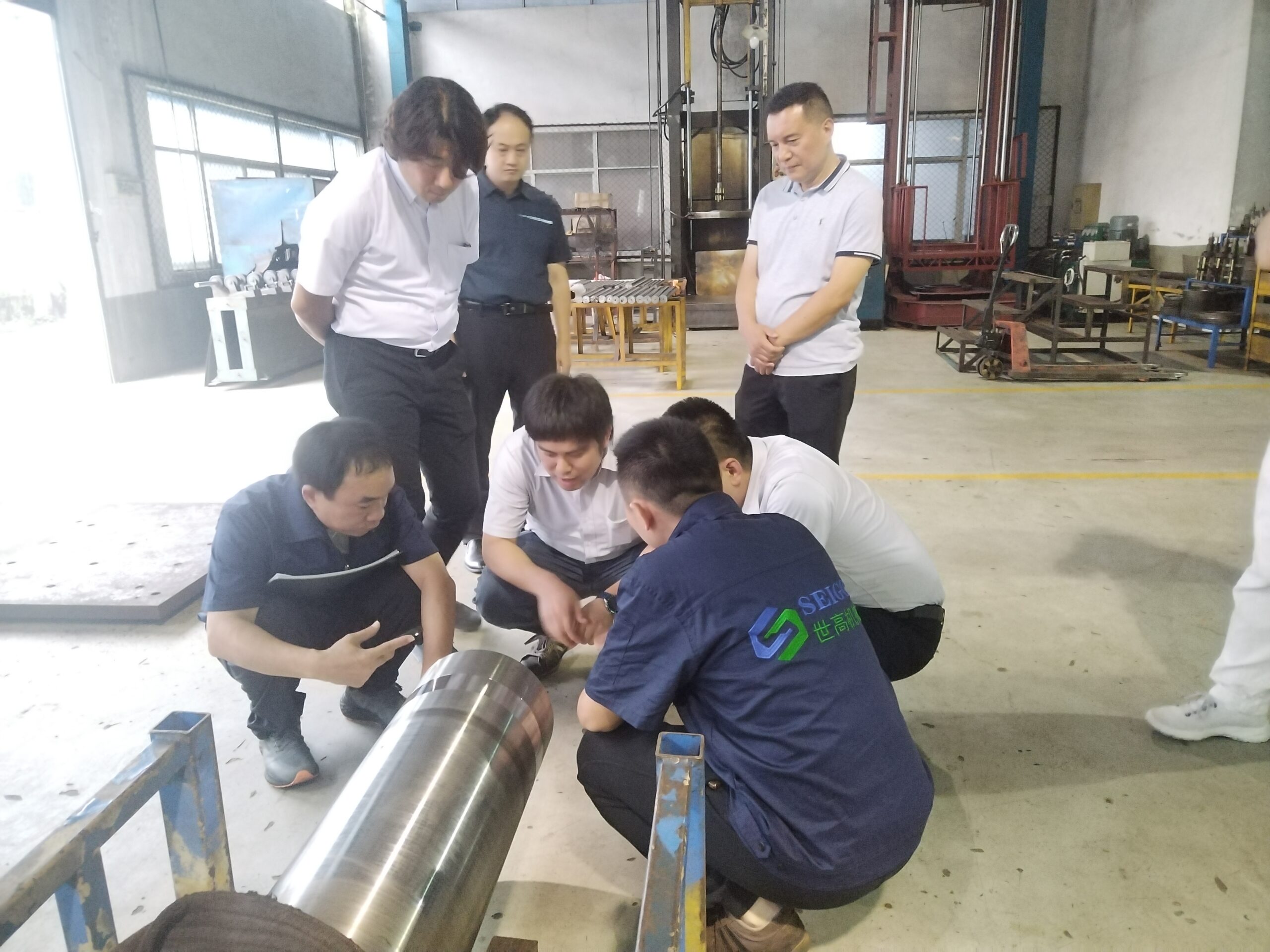
SEIGO Machinery Equipment Co. is an ISO 9001-certified manufacturer of hydraulic cylinders for Komatsu, Caterpillar, Volvo, Hitachi, John Deere, Doosan, Hyundai, XCMG and other major OEM platforms. Thirty years of OEM-grade manufacturing experience — including documented OEM supply work for Yuchai Heavy Industry and supplier-audit visits from Komatsu’s China team — with monthly capacity exceeding 6,000 units.
Disclaimer: Komatsu® and all related model designations are trademarks of Komatsu Ltd. SEIGO Machinery is not affiliated with, endorsed by, or sponsored by Komatsu Ltd. Part numbers referenced are for cross-reference identification only.
Related Reading:
- CAT Excavator Hydraulic Cylinder Replacement Guide: OEM vs Aftermarket Comparison
- How to Diagnose Hydraulic Cylinder Seal Leaks: A Field Engineer’s Troubleshooting Guide
- Tie Rod vs Welded Hydraulic Cylinders: Which Is Right for Your Heavy Equipment?