Anyone who has run a fleet of Caterpillar excavators for more than a few seasons has felt this moment: the boom cylinder starts to drift overnight, an operator radios in about a slow lift cycle, or a maintenance tech walks up with a freshly leaking gland and a number to call the dealer. Then comes the quote — and the math gets uncomfortable.
The CAT excavator hydraulic cylinder market sits at one of the widest price spreads in heavy equipment parts. A genuine Caterpillar 320 boom cylinder ordered through a dealer can run two-and-a-half to three times what a quality aftermarket replacement costs, with delivery windows ranging from same-week to over a month depending on parts availability. That spread isn’t just dealer markup. It reflects real differences in warranty coverage, manufacturing pedigree, sourcing transparency, and total cost of ownership over the next five-to-eight years of machine life.
This Caterpillar hydraulic cylinder aftermarket guide breaks down the comparison the way a fleet manager or shop supervisor actually needs to see it: real CAT part numbers, dimensional specifications, dealer pricing dynamics, what to verify on an aftermarket alternative, and the decision criteria that determine which channel is right for which situation.
CAT 320 Boom, Stick & Bucket Cylinders: The Numbers That Matter
Before the OEM vs aftermarket comparison makes sense, the underlying hardware needs to be on the table. The CAT 320 platform — covering 320, 320B, 320C, 320CL, 320D, 320DL, 320E, 320F, 320 GC, and current 320 Next Generation models — has been one of the most-produced medium hydraulic excavator families in the world. Cylinder dimensions have stayed largely consistent across generations, with serial-number-specific variations.
Representative dimensional data confirmed from CAT seal kit references and Caterpillar Parts Reference Guide documentation:
| Cylinder Position | Bore | Rod | Common CAT Part Numbers |
|---|---|---|---|
| Boom cylinder (320C / 320 L / 320 S) | 160 mm | 95 mm | 1842614, 2795614, 1069596, 6C6085 |
| Boom cylinder (320 D) | 160 mm | 110 mm | 242-6731 |
| Stick (arm) cylinder | 140 mm | 100 mm | (varies by serial) |
| Bucket cylinder | 100 mm | 65 mm | (varies by serial) |
System working pressure on the 320 platform sits at 34.3 MPa (~4,980 PSI) on most generations, with peak relief pressure occasionally reaching 35.5 MPa during heavy digging. Cylinder design pressure is set at 35 MPa working / 52.5 MPa proof, per Caterpillar internal specifications. These numbers matter because they define the engineering envelope any aftermarket replacement cylinder needs to meet — not just dimensionally, but in pressure tolerance, fatigue life, and rod chrome integrity.
The other essential detail: CAT cylinder part numbers are serial-number-dependent. A boom cylinder for a 320CL with serial prefix AXK00001-up is not the same as a boom cylinder for a 320CL with serial prefix BBL00001-up. Anyone sourcing replacement cylinders — OEM or aftermarket — without first verifying machine serial number and current cylinder part number is setting themselves up for an expensive return.
OEM Pricing Structure: Why CAT Cylinders Cost What They Cost
Caterpillar doesn’t publish list pricing on hydraulic cylinders publicly, but enough fleet operators and rebuilders share data informally that the structure is well understood across the industry.
A new genuine Caterpillar 320 boom cylinder ordered through an authorized US dealer typically lands in the $4,200 – $5,800 range for current production part numbers in standard availability. The 110mm-rod variants for larger boom assemblies run higher. CAT Reman rebuilt cylinders — Caterpillar’s own remanufactured program — sit at roughly 60–75% of new OEM pricing with full CAT warranty backing.
Several factors drive that pricing structure:
Dealer network economics. Caterpillar dealers operate under structured margin agreements that protect after-sales parts revenue. Cylinders are a profitable parts category with high replacement frequency on aging fleets. The pricing reflects a deliberate channel strategy, not raw manufacturing cost.
Inventory carrying. Authorized dealers maintain parts inventory specifically to support their installed base of CAT machines in the field. That stocking model has real cost — facilities, working capital, regional distribution — which gets recovered through unit pricing.
Warranty and engineering backing. Genuine CAT parts come with manufacturer warranty (typically 12 months / 2,000 hours, with extensions available), full Caterpillar engineering support if anything goes wrong, and unambiguous compatibility with the rest of the hydraulic system. For a machine still under warranty, OEM is often the only path that preserves coverage on adjacent components.
Tested service life. CAT publishes service life expectations for its components and stands behind them in dispute scenarios. That standardization is genuinely valuable in fleet operations where uptime tracking and maintenance forecasting depend on predictable parts performance.
The honest summary is that OEM pricing reflects what an integrated dealer network actually costs to operate, plus what genuine engineering accountability is worth. Whether that bundle is worth the premium depends entirely on the specific application.
Aftermarket Caterpillar Hydraulic Cylinder: Quality Tiers Are Real
The catch-all phrase “Caterpillar hydraulic cylinder aftermarket” covers a quality range so wide that treating it as a single category obscures the real procurement decision. There are at least three distinct tiers in the market, and the difference between them often matters more than the difference between aftermarket and OEM.
Tier 1 — Premium aftermarket / OEM-grade manufacturers. These are factories with documented ISO 9001 quality systems, frequently with direct OEM supply experience for non-CAT brands (Komatsu, Volvo, XCMG, etc.), running the same metallurgy and surface treatment standards as the OEM. Rod chrome thickness greater than 25 µm, honed 45# or 27SiMn cylinder tube, premium Japanese (NOK) or German (Parker Prädifa) seal packages, and pressure-tested at 1.5× working pressure before shipment. Pricing typically 40–55% below comparable CAT OEM.
Tier 2 — Standard aftermarket / general replacement market. These cylinders meet basic dimensional spec and operate adequately under normal duty, but cut corners on materials and process. Thinner chrome (15–20 µm), commodity-grade seals, less rigorous pressure testing, often with inconsistent rod surface finish. Pricing typically 55–70% below OEM. Acceptable for older machines past warranty, light-duty applications, or short-term backup equipment. Not appropriate for primary production machines under heavy duty.
Tier 3 — Budget / open-market commodity. Lowest-tier units often sourced through general B2B marketplaces with limited supplier verification. Pricing 70–85% below OEM but quality varies from acceptable-but-short-lived to outright dangerous. Documented failures include early seal degradation within 500 hours, rod chrome flaking, and weld integrity issues at end-cap-to-barrel joints. Material cost savings come from somewhere; in this tier it comes from places that affect cylinder safety.
The procurement question isn’t “OEM or aftermarket.” It’s “OEM or which tier of aftermarket.” Treating those as the same question is how fleet operators end up burned twice — once by underspeccing the cylinder and once by re-buying it at OEM pricing nine months later.
Side-by-Side Comparison: CAT OEM vs Premium Aftermarket Replacement
The fairest comparison runs OEM against Tier 1 premium aftermarket — that’s where the procurement decision lives most of the time. Tier 2 and Tier 3 comparisons are mostly about budget triage, not engineering equivalence.
| Specification | Genuine CAT (New OEM) | Tier 1 Premium Aftermarket |
|---|---|---|
| Working pressure rating | 35 MPa (5,076 PSI) | 35 MPa (5,076 PSI) |
| Proof pressure | 52.5 MPa (7,615 PSI) | 52.5 MPa (7,615 PSI) |
| Cylinder tube material | 27SiMn (or equivalent) | 27SiMn / 45# honed |
| Rod chrome thickness | 25–30 µm | 25–35 µm |
| Rod surface roughness (Ra) | ≤0.2 µm | ≤0.2 µm |
| Seal package | CAT proprietary / Parker | NOK (Japan) / Parker Prädifa |
| Pressure test before ship | 100% at 1.5× working | 100% at 1.5× working |
| Warranty | 12 months / 2,000 hours | 12 months (typical premium tier) |
| Delivery (US) | 2–6 weeks (stock dependent) | 35–45 days factory direct |
| Cross-reference to CAT P/N | Direct match | Verified per P/N |
| Typical landed price (320 boom) | $4,200 – $5,800 | $1,850 – $2,400 |
The pattern is consistent across cylinder positions on the 320 platform. A Tier 1 premium aftermarket CAT 320 boom cylinder typically delivers 90–95% of the OEM’s measurable specifications at 40–55% of the OEM’s price. That gap closes further on stick and bucket cylinders, where the engineering envelope is less demanding than boom service.
What the comparison table doesn’t capture is the variation within Tier 1 itself. Two premium aftermarket manufacturers can both meet the specifications above and still differ meaningfully on actual field performance — usually because of process consistency rather than headline specs. Quality systems documentation, factory audit history, and verifiable OEM supply work for major brands are the difference between specs on paper and parts that actually perform like OEM in the field.
5-Year Total Cost of Ownership: Where the Real Numbers Live
The single-unit price comparison is misleading. The decision that actually matters is total cost of ownership across a representative service window — typically five years on a working excavator, or roughly 8,000–12,000 operating hours.
Cost model for a CAT 320 boom cylinder replacement decision, single unit, 5-year window:
| Cost Component | Genuine CAT (OEM) | Tier 1 Aftermarket | Tier 2 Aftermarket |
|---|---|---|---|
| Purchase price | $5,000 | $2,100 | $1,400 |
| Installation labor (8 hrs @ $125/hr) | $1,000 | $1,000 | $1,000 |
| Estimated re-seal at year 3 (parts + labor) | $850 | $850 | $850 |
| Replacement probability (Year 4–5) | 5% | 10% | 35% |
| Probability-weighted replacement cost | $300 | $310 | $840 |
| 5-year downtime exposure (estimated) | Low | Low | Medium |
| Total 5-year cost | $7,150 | $4,260 | $4,090 |
| Cost vs. OEM | — | -40% | -43% |
A few notes on this model. Replacement probability at Year 4–5 is the biggest variable separating Tier 1 from Tier 2 aftermarket. The 10% figure for Tier 1 reflects field data from premium manufacturers with documented OEM supply experience; the 35% for Tier 2 reflects general aftermarket failure rates from fleet operator reporting. Downtime cost — operator wages, project delays, rental backup equipment — isn’t quantified in this table but easily adds $1,200–$3,500 per hour of unplanned excavator downtime depending on application.
The honest read on the model: Tier 1 premium aftermarket delivers OEM-comparable 5-year economics at roughly 60% of the cost. Tier 2 saves marginally more in nominal terms but loads the back end of the ownership cycle with re-buy risk that often eats the upfront savings. Tier 3 isn’t on the table for any serious fleet operation.
How to Verify Aftermarket Compatibility — The Practical Checklist
The cross-reference process for aftermarket CAT excavator hydraulic cylinder sourcing is straightforward, but skipping any step is how procurement gets expensive. Working order:
1. Confirm machine serial number prefix and full serial number. The 320 family alone has 15+ serial number group designations (BBE, BBL, BCN, BDE, BEA, BMZ, DBG, EGL, GLA, JTG, AXK, MYK, KTN, LKS, HEX) — each potentially specifying a different cylinder configuration. Caterpillar’s Parts Reference Guide for the 320/320 GC family lists these explicitly.
2. Pull the current CAT cylinder part number from the dealer parts system or the machine’s existing label. Reference the bore and rod dimensions independently when possible (160 mm × 95 mm vs. 160 mm × 110 mm changes everything downstream).
3. Verify aftermarket supplier cross-reference to the exact CAT P/N. Request the supplier’s bore/rod/stroke dimensions in writing and compare against measured cylinder data from the machine. Don’t rely on a marketing claim of “fits all 320” — variants exist.
4. Confirm mounting pin diameter, pin-to-pin distance, port location, and rod thread. These are the four interface points where dimensional drift between aftermarket variants causes installation problems. Premium aftermarket manufacturers will provide a full mechanical drawing with the quote; supplier shyness about drawings is a red flag.
5. Request seal package specification. “Premium seals” is meaningless. NOK, Parker, Trelleborg, Hallite — those are real seal brands. Specifying the seal vendor and series eliminates a common quality gap.
6. Verify pressure test certification. Premium aftermarket cylinders should ship with individual pressure test certificates at 1.5× working pressure. If the supplier can’t produce one, the testing didn’t happen.
7. Confirm warranty terms in writing. 12 months is the premium aftermarket standard. Shorter coverage indicates a Tier 2 or Tier 3 product regardless of how the supplier describes itself.
This checklist takes roughly 30 minutes per cylinder line and eliminates the vast majority of aftermarket sourcing problems. Skip any step and the failure mode is predictable.
When OEM Is the Right Call — and When It Isn’t
A clean decision framework based on actual procurement experience:
OEM CAT is the right choice when:
- Machine is under active warranty and OEM parts are required to preserve coverage
- Fleet operates under strict OEM-only maintenance contracts (rental fleets, certain government contracts, mining operations with specific compliance requirements)
- Cylinder is on a current-production machine still being built — parts availability is reliable and warranty backing is strongest
- Application is mission-critical with high downtime cost where OEM engineering support has demonstrable value
- Resale plans include OEM-only documentation as part of machine valuation
Tier 1 premium aftermarket is the right choice when:
- Machine is past warranty and outside extended coverage windows (most fleets after Year 3)
- Cost-sensitive replacement program where 40–55% savings funds other fleet maintenance
- Supplier has documented OEM-supply credentials for major brands (Komatsu, Volvo, etc.)
- Equipment is in active use but operating outside Caterpillar’s premium dealer support footprint
- Multiple cylinder replacements across a fleet — the cost compounding is significant
Avoid Tier 2 / Tier 3 for primary production equipment. Acceptable only for backup machines, training fleet, or short-term lease-return situations where cylinder life beyond 12–18 months isn’t required.
SEIGO’s CAT-Compatible Cylinder Program
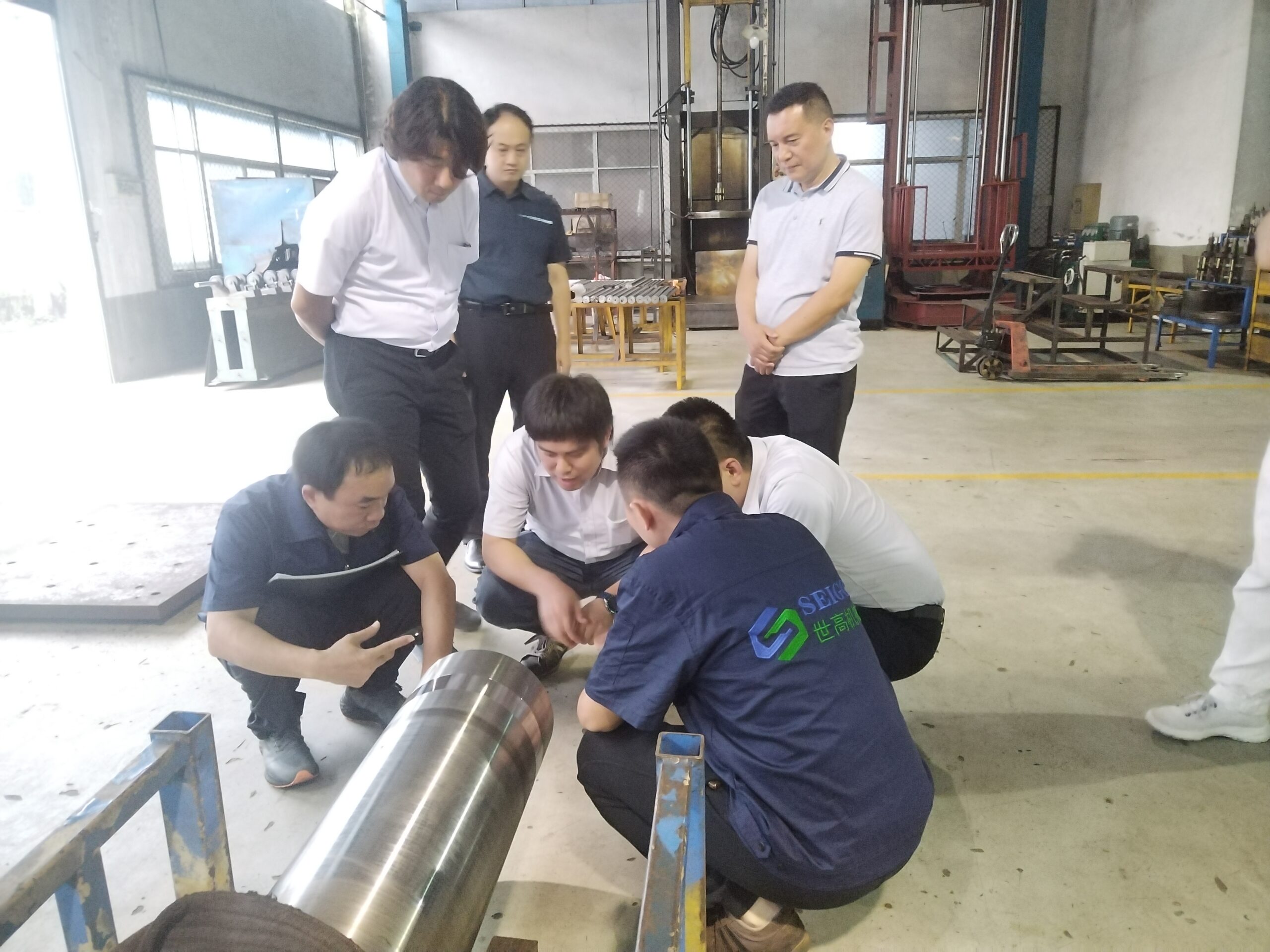
SEIGO Machinery operates as a Tier 1 premium aftermarket manufacturer for CAT excavator hydraulic cylinder replacement across the 320, 325, 330, 336, 349, 365, 374, 385, and 390 platforms. Cross-reference for any CAT cylinder part number returns within one business day with a complete mechanical drawing, sealed dimensional confirmation, and a factory-direct quote.
What that translates to operationally:
- Direct OEM supply experience with documented audit history for SANY, Yuchai Heavy Industry — the supplier qualification standards apply across all aftermarket production.
- 27SiMn / 45# honed cylinder tube with rod chrome thickness ≥25 µm and surface roughness Ra ≤0.2 µm — meeting or exceeding CAT internal specification on every shipped cylinder.
- NOK Japan seal packages standard, with Parker Prädifa available on request for severe-duty applications.
- 100% pressure test at 1.5× working pressure before shipment, with individual test certificate accompanying every unit.
- 12-month / 2,000-hour warranty matching premium aftermarket industry standards.
- 35–45 day factory-direct lead time with rapid-production track available for urgent fleet downtime situations.
- DDP delivery available to US, Canada, Mexico, and Australia for buyers preferring landed-cost simplicity.
For fleet operators running multiple CAT excavators past initial warranty windows, SEIGO’s CAT-compatible cylinder program delivers OEM-comparable specifications at 40–55% below dealer pricing, with engineering documentation that holds up against the verification checklist above.
Cross-Reference Your CAT Cylinder Part Number
Send the OEM part number, machine model, and serial prefix. SEIGO’s engineering team returns a sealed mechanical drawing and factory-direct quote within one business day.
Request a CAT Cylinder Cross-Reference Quote → Download the SEIGO Cylinder Catalog (PDF) →
SEIGO Machinery Equipment Co. is an ISO 9001-certified manufacturer of hydraulic cylinders for Caterpillar, Komatsu, Volvo, Hitachi, John Deere, and other major OEM platforms. Thirty years of OEM-grade manufacturing experience, monthly capacity exceeding 6,000 units, and CAT-compatible aftermarket programs across the full medium and large excavator range.
Disclaimer: Caterpillar®, CAT®, and all related model designations are trademarks of Caterpillar Inc. SEIGO Machinery is not affiliated with, endorsed by, or sponsored by Caterpillar Inc. Part numbers referenced are for cross-reference identification only. Pricing data reflects general market observations and may vary by region, dealer, and date.
Related Reading:
- Tie Rod vs Welded Hydraulic Cylinders: Which Is Right for Your Heavy Equipment?
- Tariff Impact on Hydraulic Cylinder Procurement 2026: How US Buyers Can Protect Their Supply Chain
- The Complete Guide to Hydraulic Cylinder Sizing: How to Calculate Force, Speed & Stroke for Excavators