Walk through any working construction site and look at the cylinders on the excavators, loaders, and dozers. They’re welded. Walk into any factory automation cell, plastic injection plant, or stamping press operation, and look at the cylinders there. They’re tie-rod. This pattern isn’t accidental, and it isn’t decided by tradition. It’s the product of pressure ratings, side-load tolerance, repairability, and standardization — four variables that pull in opposite directions depending on where the cylinder is going to live.
The tie rod vs welded hydraulic cylinder decision shows up most often during equipment specification, replacement sourcing, or a redesign of an aftermarket cylinder program. Get it wrong and the symptom is rarely catastrophic failure. It’s quiet, expensive underperformance — premature rebuilds, side-load wear, leaking ports, or a maintenance bill that creeps up year after year. This article breaks the comparison down the way procurement engineers and maintenance leads actually need it: technical structure first, pressure and durability second, repairability third, and a clean decision framework at the end.
How Tie Rod Cylinders Are Actually Built
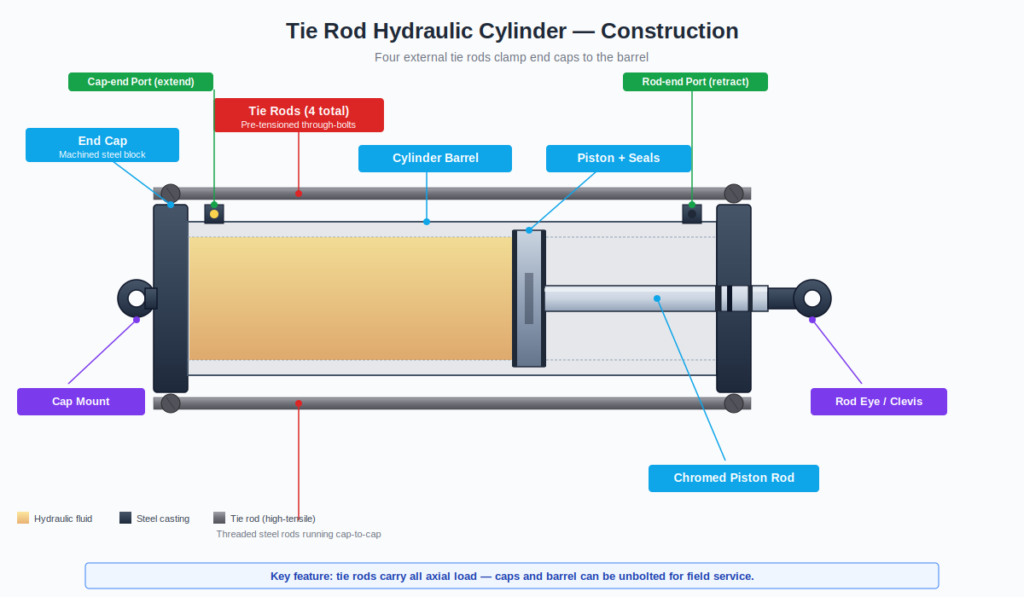
A tie rod hydraulic cylinder uses four (sometimes more) high-tensile threaded steel rods running the full length of the barrel, externally clamping two end caps onto a honed steel tube. The seal between the barrel and end caps is a static O-ring sitting in a machined groove on each end cap face. The tie rods carry the entire longitudinal hydraulic force. The barrel itself only contains pressure radially — it doesn’t transmit force from one end to the other.
This sounds simple because it is. Tie rod construction is the oldest mass-produced cylinder architecture still in regular use, and it owes most of its market position to a single fact: standardization. The NFPA/T3.6.7 standard (Square Head Industrial Cylinders — Mounting Dimensions) and the parallel ISO 6020/6022 standards lock in bore-to-rod combinations, port locations, and mounting interfaces. A 4-inch bore NFPA tie-rod cylinder from one manufacturer drops into the same machine slot as a 4-inch bore NFPA cylinder from any other. That’s why factory automation lives on tie-rod: replacement is a same-day parts-counter exercise, not an engineering project.
Standard NFPA tie-rod working pressure rating sits at 3,000 PSI (207 bar / 20.7 MPa) for heavy-duty industrial service, with light-duty versions rated 2,500 PSI. The standard proof pressure (the burst-verification figure under NFPA/T3.6.29) runs 1.5× working pressure — so a stock 3,000 PSI cylinder is verified to hold roughly 4,500 PSI without permanent deformation. Burst pressure on common Parker, Prince, and Milwaukee Cylinder builds typically lands around 5,000 PSI.
Above 3,000 PSI continuous, tie rods enter a region where the design starts to argue with itself. The rods elongate under load. End cap seating loses preload during pressure spikes. Procurement teams in pressure-critical applications report a phenomenon called “breathing” — micro-flexing of the end-cap-to-barrel interface that produces slow seep leaks indistinguishable from a bad O-ring. This is the structural ceiling of the tie-rod architecture, and it’s the single largest reason mobile heavy equipment manufacturers walked away from tie-rod construction decades ago.
How Welded Cylinders Are Built
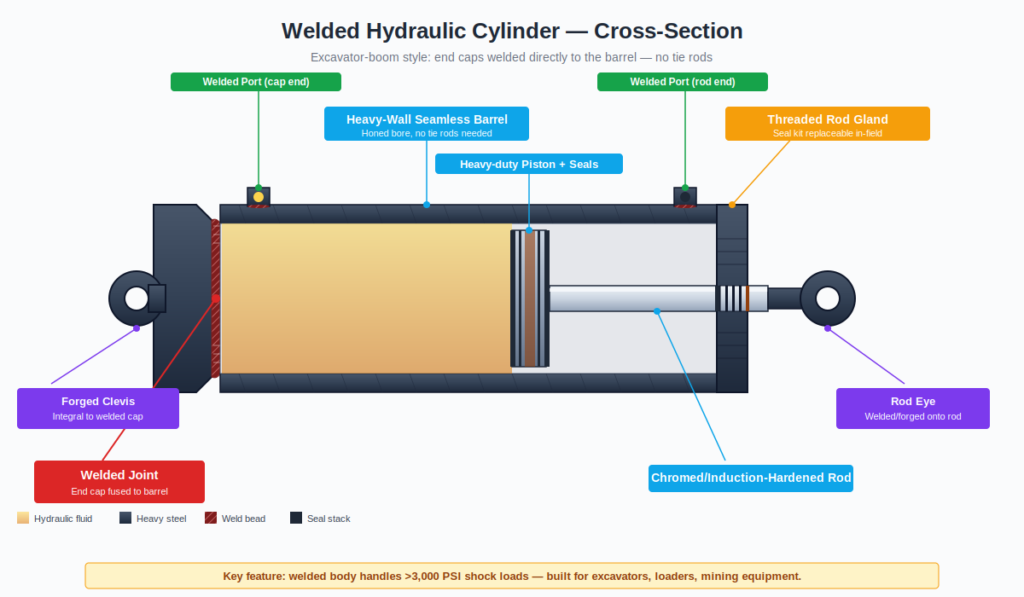
A welded hydraulic cylinder takes a different approach to the same problem. Instead of clamping end caps with external rods, the end caps (technically called “head” and “cap” — gland end and blind end) are circumferentially welded directly to the barrel tube. The pressure boundary becomes a single fused structure. There are no tie rods to manage, no preloaded threaded joints, no static O-rings between end cap and tube. The welds carry the longitudinal force; the barrel walls handle the radial.
What this gives up in repairability, it gains back in pressure capacity, compactness, and side-load tolerance. Most welded cylinders for construction equipment are rated 3,000 PSI continuous and 5,000 PSI peak — and that’s the conservative end. Severe-duty welded cylinders for mining shovels, demolition shears, and forestry processors are routinely built to 5,000 PSI continuous, with high-pressure ranges extending to 10,000 PSI in specialized industrial applications. The welded cylinder excavator boom, stick, and bucket cylinders running on a Komatsu PC200, CAT 320, or Volvo EC210 all sit in the 30–35 MPa (4,400–5,100 PSI) working pressure band.
Compactness comes from eliminating the external tie rod hardware. A welded cylinder of equivalent force capacity will be roughly 15–25% smaller in outside envelope dimensions than its NFPA tie-rod counterpart. On an excavator boom, where the cylinder lives inside a tight steel cradle that already has to clear bucket pivots and hydraulic line routing, that envelope difference isn’t a luxury. It’s the reason the welded architecture exists on this category of equipment at all.
Side-load tolerance is the third structural advantage. Tie-rod cylinders depend on perfectly axial loading to keep all four rods in equal tension. Any off-axis force unequally loads the tie rod set and concentrates fatigue on the lightly-loaded rods (which see compressive stress reversal). A welded cylinder, with its monolithic pressure boundary, distributes side loads through the full cross-section of the barrel wall — the architecture is simply more forgiving of the real-world abuse that mobile equipment subjects cylinders to.
Why Heavy Equipment Almost Always Chooses Welded
The pattern at the top of this article isn’t coincidence. Once the operating pressure crosses 3,000 PSI working, the side load profile becomes unpredictable, or the available space envelope tightens, the welded architecture becomes the only sensible answer. Construction equipment hits all three conditions at once.
A representative example: the boom cylinder on a Komatsu PC200-class excavator runs 140 mm bore × 95 mm rod at 35 MPa (5,080 PSI) system pressure. The cylinder gets side-loaded every time the operator swings under load, every time the bucket catches a rock against the dig direction, every time the machine tracks across uneven ground with the boom raised. The cylinder lives inside a structural cradle with maybe 10–15 mm of envelope clearance on each side. A tie-rod cylinder of equivalent specification simply does not fit — and would not survive the duty cycle if it did.
The same logic plays out across the rest of the heavy equipment fleet. A wheel loader hydraulic cylinder controlling lift arm articulation. A dump truck hydraulic cylinder driving body hoist with telescoping multi-stage construction. A drill rig hydraulic cylinder running mast cylinder strokes of 8–10 meters under high pressure and outdoor exposure. None of these can be served by a standard NFPA tie-rod platform. All of them are welded by default.
The exceptions are narrow and they prove the rule:
- Compact and skid-steer loaders at the lower end of the mobile equipment range. Some manufacturers use shorter-stroke tie-rod cylinders at the 2,500–3,000 PSI operating range, particularly in older Bobcat and CAT skid steer models. These are being phased out in newer designs in favor of welded construction for both cost and durability reasons.
- Agricultural cylinders on certain tractor implements and pull-behind equipment, where standardization and farmer field-repairability outweigh pressure requirements. Standard 3,000 PSI tie-rod cylinders from Cross, Prince, and Chief dominate this segment.
Outside those niches, the welded architecture owns the mobile heavy equipment market for a reason that comes down to physics, not marketing.
Pressure Rating: Side-by-Side Numbers
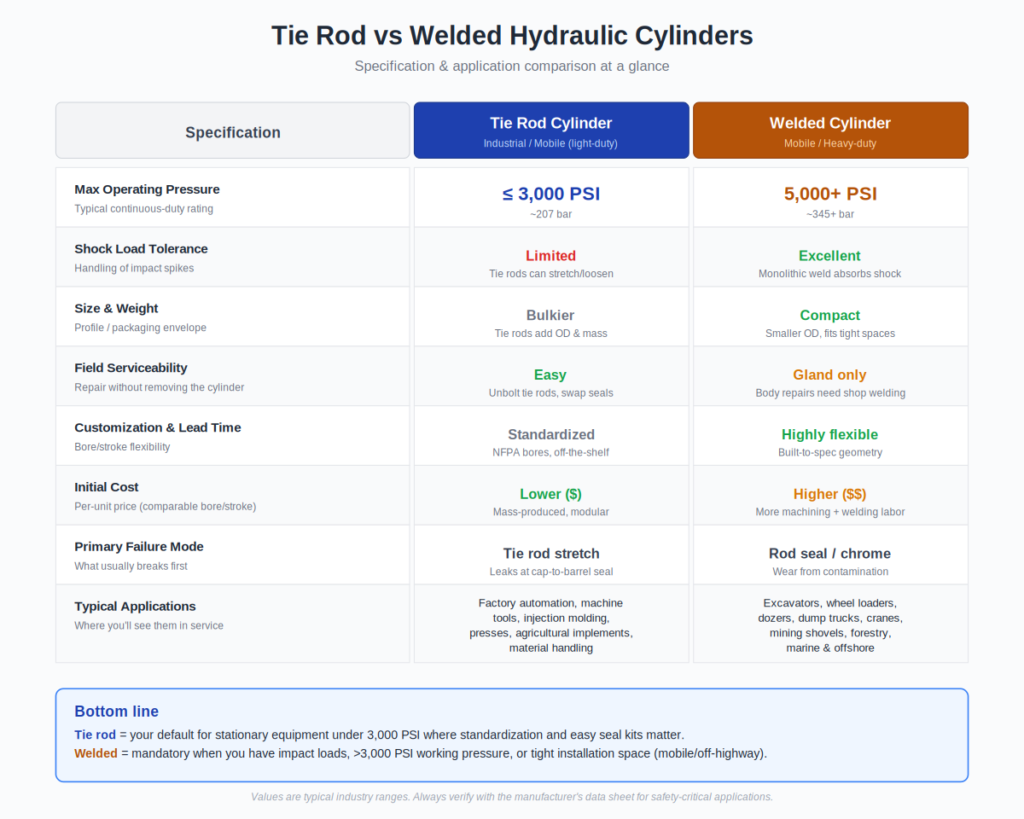
The numerical comparison clarifies how the two architectures actually stack up across the variables that determine cylinder selection:
| Specification | Tie Rod (NFPA Heavy Duty) | Welded (Standard Mobile) | Welded (Severe Duty) |
|---|---|---|---|
| Working pressure | 3,000 PSI (207 bar) | 3,000 PSI (207 bar) | 5,000 PSI (345 bar) |
| Peak/proof pressure | 4,500 PSI (310 bar) | 5,000 PSI (345 bar) | 7,500 PSI (517 bar) |
| Burst pressure | ~5,000 PSI (345 bar) | 10,000+ PSI (689+ bar) | 15,000+ PSI (1,034+ bar) |
| Typical bore range | 1.5″ – 20″ | 1.5″ – 24″ | 2″ – 30″ |
| Typical stroke range | up to 120″ | up to 240″ | up to 300″ |
| Side load tolerance | Low – Moderate | High | High |
| Standardized interchangeability | NFPA / ISO 6020 / ISO 6022 | None industry-wide | None industry-wide |
A few observations on the pattern. The working pressure parity at 3,000 PSI is real for entry-level applications — at that pressure ceiling, either architecture works. The divergence begins above 3,000 PSI, where the welded structure scales cleanly and the tie-rod architecture fights its own preload geometry. By 5,000 PSI, the choice is essentially made for the buyer. By 10,000 PSI, only welded construction is in the conversation.
The other meaningful difference is the standardization column. NFPA and ISO interchangeability is the single largest reason tie-rod cylinders persist in factory automation: when the cylinder fails at 2 AM on a production line, replacement is a same-shift fix because the spare is dimensionally identical. Welded cylinders carry no such standard. A welded boom cylinder for a Komatsu PC200 is not interchangeable with a welded boom cylinder for a Hitachi ZX200, even though both machines are in the same weight class doing the same work. This is the trade-off the mobile equipment industry made and has not been willing to unwind.
Maintainability: The Repair Cost Picture
Tie-rod cylinders win the repairability comparison decisively, and that needs to be acknowledged honestly because it’s the one place tie-rod construction has a real durable advantage.
A tie-rod hydraulic cylinder rebuild is a workbench procedure with standard tools: loosen the four tie rod nuts, slide off the end caps, pull out the piston-and-rod assembly, replace the seal kit, and reassemble. A competent hydraulic technician can complete the operation in 45–90 minutes depending on cylinder size. Seal kits are stocked by every regional hydraulic distributor in NFPA-standard configurations. The total cost of a tie-rod rebuild typically runs $80–$250 in parts plus 1–2 hours of labor.
A welded cylinder rebuild is fundamentally a different procedure. The end caps cannot be removed without destroying the weld, so service access happens through the gland end — the threaded or retainer-ring assembly that holds the rod seal and bearing. Internal piston seals, the piston-to-rod connection, and any internal damage to the barrel are only accessible by partial disassembly through the gland-side opening. Heavy-duty welded cylinders with damaged barrels often require either honing on a specialized cylinder hone (most repair shops don’t have one above 6-inch bore capacity) or full barrel replacement, which means cutting the weld and re-welding — a procedure that essentially destroys factory warranty and creates a new weld inspection liability.
The practical implication for a procurement decision is this: a welded cylinder has lower acquisition cost per pound of force in the heavy-equipment range, and longer first-life expectancy because the architecture handles the pressure and side load better — but the rebuild economics flip the comparison. For applications where rebuilds are expected as part of normal lifecycle maintenance, this is a real cost consideration that shouldn’t be hidden in the fleet operations budget.
Three field observations on the repair math:
- For mobile heavy equipment cylinders in the 3,000–5,000 PSI range, replace-rather-than-rebuild is increasingly the prevailing economics. The labor cost of removing a boom cylinder from a 20-ton excavator dominates the rebuild-versus-replace decision. If the cylinder is already on the workbench because it had to come off, replacement of the entire unit often costs less than a thorough rebuild — particularly with factory-direct aftermarket pricing.
- For lower-pressure mobile equipment (skid steers, smaller telehandlers), the calculation can favor rebuilding tie-rod cylinders, especially when an NFPA-standard cylinder is the original design.
- For severe-duty mining and demolition cylinders, factory-rebuild-or-replace programs from the original manufacturer or a high-quality aftermarket supplier are the dominant approach. Field rebuilds at this duty level rarely survive their second cycle.
Selection Decision Framework
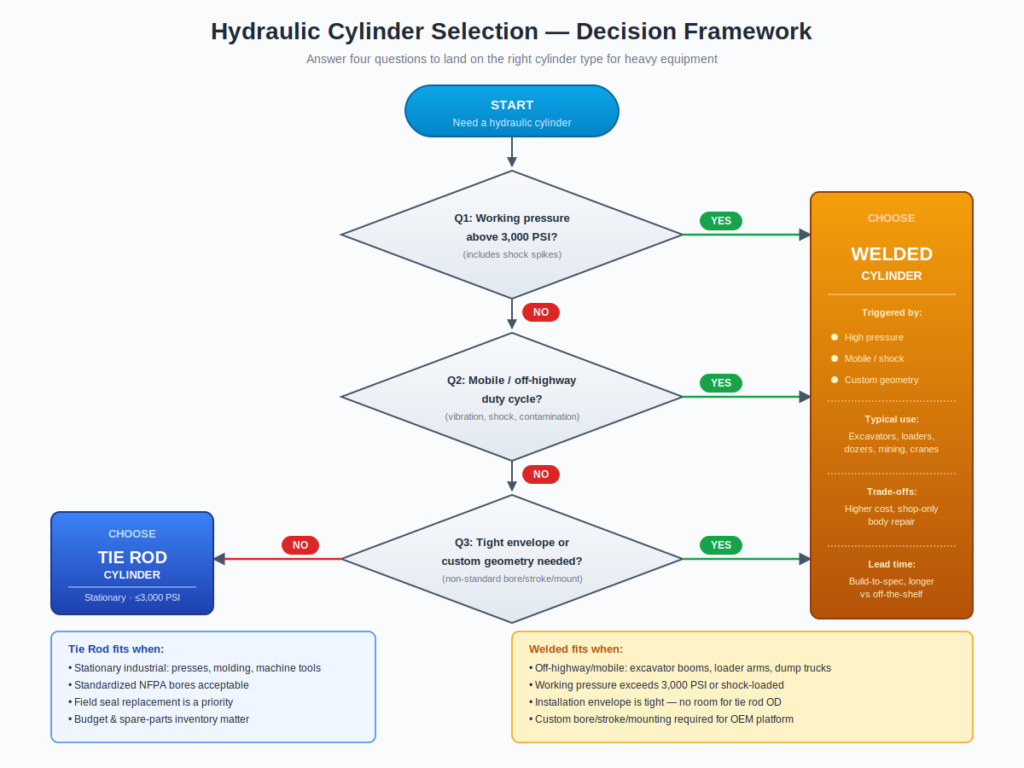
The choice between tie rod and welded hydraulic cylinders comes down to a small number of inputs that anyone specifying a cylinder needs to put on the table before sourcing.
Working pressure
- Below 3,000 PSI continuous: either architecture works. Decide on standardization and repair access.
- 3,000–5,000 PSI continuous: welded preferred for mobile equipment; tie-rod acceptable only in low-side-load, static industrial applications.
- Above 5,000 PSI continuous: welded architecture only.
Application environment
- Factory floor, climate-controlled, predictable load profile: tie-rod is well-suited.
- Mobile equipment, outdoor exposure, shock loading, side-load uncertainty: welded.
- Mining, drilling, demolition, severe environmental exposure: severe-duty welded only.
Available envelope
- Generous mounting space, straight load path: either works.
- Tight cradle, structural integration with the machine: welded for compactness.
Repair access and lifecycle expectations
- Frequent rebuild cycles, in-house service capability: tie-rod cost-effective.
- Heavy equipment lifecycle, replace-on-failure model: welded.
Standardization need
- Cross-machine interchangeability required: NFPA/ISO tie-rod.
- Equipment-specific custom hydraulic cylinder design: welded.
For most heavy equipment procurement decisions — excavator hydraulic cylinder replacement, wheel loader boom and tilt cylinders, dump truck hoist systems, drill rig mast and feed cylinders — the table above resolves in the same direction: welded construction, equipment-specific dimensions, sourced either from the OEM or from a qualified aftermarket manufacturer with documented OEM-grade quality standards.
How SEIGO Approaches Both Architectures
SEIGO Machinery manufactures both welded and tie-rod hydraulic cylinder configurations, with welded cylinder excavator and heavy equipment programs as the core production focus. Standard welded cylinder builds run 3,000–5,000 PSI working pressure across 1.5″–24″ bore ranges, with severe-duty mining-class cylinders extending the pressure envelope to 7,500 PSI. NFPA-standard tie-rod cylinders are available for industrial automation and agricultural OEM applications where standardization matters more than peak pressure.
Where the choice between architectures is genuinely ambiguous — typically in the 3,000 PSI mobile equipment range with light side-load profile — SEIGO’s engineering team will run the trade-off analysis as part of the quote process. CAD review and a complete sized drawing turn around within 24 hours of receiving the application data. ISO 9001 quality systems, documented OEM relationships, and 30 years of manufacturing history sit behind every quote.
For aftermarket replacement programs, dimensional cross-reference against any major OEM part number (Komatsu, CAT, Volvo, Hitachi, Doosan, Hyundai, John Deere, XCMG) is a same-business-day service. Send the OEM part number and the machine model — SEIGO’s engineering team will confirm whether the application is best served by a welded or tie-rod design and provide a factory-direct quote that includes full landed cost.
Need help choosing the right architecture for your application?
SEIGO’s engineering team can specify, quote, and document delivery for both welded and NFPA-standard tie-rod hydraulic cylinder configurations within 24 hours.
Request a Custom Quote → Download the Cylinder Catalog (PDF) →
SEIGO Machinery Equipment Co. is an ISO 9001-certified manufacturer of hydraulic cylinders for excavators, wheel loaders, dump trucks, drill rigs, and industrial applications. Thirty years of OEM-grade manufacturing experience, monthly capacity exceeding 6,000 units, and engineering CAD turnaround within one business day. Factory-direct pricing for global distributors and equipment fleets.
Related Reading:
- The Complete Guide to Hydraulic Cylinder Sizing: How to Calculate Force, Speed & Stroke for Excavators
- Tariff Impact on Hydraulic Cylinder Procurement 2026: How US Buyers Can Protect Their Supply Chain
- Top 5 Hydraulic Cylinder Gland Types You Need to Know
Standards & References:
- NFPA/T3.6.7 R3-2009 (R2024) — Square Head Industrial Cylinders, Mounting Dimensions
- NFPA/T3.6.29 R2-2000 (R2024) — Tie Rod or Bolted Cylinder Pressure Rating
- ISO 6020-1, ISO 6020-2, ISO 6022 — International tie-rod cylinder dimensional standards
- NFPA/T3.6.59-1993 (R2024) — Cylinders, Cushion Performance