Every procurement decision on a heavy equipment hydraulic cylinder comes down to a choice between three channels: buy genuine from the OEM dealer, buy aftermarket from a distributor, or buy factory-direct from the manufacturer. The unit prices across those three channels can vary by a factor of three or more for the same physical part — and the cheapest option is not automatically the right one, while the most expensive option is not automatically the safest.
The costliest mistake in parts procurement is buying on unit price alone. For a component like a hydraulic cylinder — where a failure in the field can idle a machine, delay a project, and trigger cascading costs many times the part’s purchase price — acquisition cost barely matters next to total cost of ownership. A cheap cylinder that fails early, ships late, or arrives to the wrong spec can cost thousands of times its unit price in downtime, warranty claims, and rework. A sharp sourcing strategy judges the decision on lifecycle cost, not sticker price.
This guide is the sourcing framework for heavy equipment hydraulic cylinder procurement: what each channel actually delivers, how to distinguish real quality tiers within the aftermarket, how to control the risks of factory-direct sourcing, a 3-year total cost of ownership comparison across all three channels, and a decision matrix for determining which channel fits which situation.
Channel 1: OEM Direct — When Genuine Is Worth the Premium
OEM (Original Equipment Manufacturer) cylinders are produced by the company that built the machine, or by a licensed partner, under the OEM’s engineering specifications. For a Caterpillar excavator, that’s a genuine CAT hydraulic cylinder from a CAT dealer; for a Komatsu, a genuine Komatsu cylinder, and so on.
The pricing logic. OEM cylinders carry the highest unit price in the market, typically running 40–80% above comparable premium aftermarket alternatives. That premium isn’t arbitrary. It reflects a specific bundle: the dealer network economics that fund parts availability and field support, the inventory carrying cost of stocking parts against an installed base, the manufacturer’s engineering warranty backing, and the documented service-life standards the OEM publishes and stands behind.
When OEM is genuinely the right choice:
- Machine under active warranty. Using non-OEM parts can void coverage on adjacent hydraulic system components. For a machine still within its warranty window, OEM is often the only path that preserves coverage.
- OEM-only maintenance contracts. Rental fleets, certain government contracts, and mining operations with specific compliance requirements sometimes mandate OEM parts regardless of cost.
- Current-production machines. Parts availability is reliable and warranty backing is strongest for machines still being built.
- Mission-critical, high-downtime-cost applications where the value of guaranteed engineering support outweighs the price premium.
- Resale considerations where OEM-only maintenance documentation contributes to machine valuation.
The honest limitation. For a machine past its warranty window — which describes most working fleets after Year 3 of ownership — the OEM premium buys a level of assurance that a quality aftermarket alternative can frequently match at significantly lower cost. The premium is real, but so is the alternative.
Channel 2: Aftermarket — Where the Quality Tiers Are Everything
“Aftermarket” is a category so broad that treating it as a single option is the root of most bad sourcing decisions. The quality range within the aftermarket is wider than the gap between the aftermarket and OEM, which means the real decision isn’t “OEM or aftermarket” — it’s “OEM, or which tier of aftermarket.”
There are three distinct tiers, and the difference between them shows up not on day one but at the 2,000-hour mark.
Tier 1 — Premium aftermarket / OEM-grade. Manufacturers with documented ISO 9001 quality systems, frequently with direct OEM supply credentials for major brands. These cylinders match or exceed OEM material specifications: rod chrome thickness ≥25 µm, honed 27SiMn or 45# cylinder tube, premium seal packages (NOK Japan, Parker Prädifa Germany), and 100% pressure testing at 1.5× working pressure. Pricing typically runs 40–55% below comparable OEM. A properly-built Tier 1 cylinder delivers 90–95% of the OEM’s measurable specifications and comparable field service life.
Tier 2 — Standard aftermarket. Meets basic dimensional specifications and operates adequately under normal duty, but cuts corners on materials and process. Thinner chrome (15–20 µm), commodity-grade seals, less rigorous pressure testing, inconsistent rod surface finish. Pricing runs 55–70% below OEM. Acceptable for older machines past warranty, light-duty applications, or short-term backup equipment. Service life typically 50–70% of OEM equivalent. Not appropriate for primary production machines under heavy duty.
Tier 3 — Budget / commodity. Lowest-tier units, often sourced through general B2B marketplaces with limited supplier verification. Pricing 65–85% below OEM, but quality ranges from acceptable-but-short-lived to outright unsafe. Documented failures include early seal degradation within 500 hours, rod chrome flaking, and weld integrity problems. The material cost savings come from somewhere, and in this tier they come from places that compromise cylinder safety.
The practical lesson: aftermarket sourcing done well means qualifying to Tier 1. A representative data point from a 2024 comparison test on a South African platinum mine found that quality aftermarket parts achieved 94% of OEM service life at 48% lower cost — but the deciding factor was the supplier’s documented in-house testing that matched OEM specifications. That’s the difference between Tier 1 and everything below it: verifiable quality systems, not just a lower price.
Channel 3: Factory Direct — Capturing the Margin Chain, Controlling the Risk
Factory-direct sourcing means buying the cylinder directly from the manufacturer rather than through the importer-distributor-dealer chain. Done with a qualified manufacturer, this captures the margin that would otherwise be distributed across the intermediary layers — the single largest pool of recoverable cost in most hydraulic cylinder supply chains.
The margin math. A typical aftermarket cylinder priced at $2,600 on a US distributor’s shelf has moved through: Chinese factory FOB price around $1,100, importer/wholesaler landed cost with duties around $1,710, distributor gross margin bringing it to roughly $2,400, and dealer markup to $2,640. Factory-direct procurement doesn’t eliminate the tariff layer, but it eliminates the layered intermediary margins that sit on top of it. For buyers moving meaningful volume, that recoverable margin funds significant savings.
The risks that need controlling. Factory-direct sourcing carries real risks that the distributor layer normally absorbs — supplier misrepresentation, quality variance, communication gaps, and logistics complexity. The risk-control framework:
- Verify the manufacturer is actually a manufacturer. Trading companies present themselves as factories. Confirm business license shows manufacturing scope, verify through Tianyancha or Qichacha, and require a production facility video walkthrough.
- Confirm ISO 9001 through the IAF CertSearch database (iaf.nu), not a self-issued PDF. A certificate that doesn’t appear in the IAF database isn’t a certification.
- Require documented engineering specifications — rod chrome thickness, tube material, pressure test protocol, seal vendor — in writing, with the correct numerical answers, not marketing adjectives.
- Demand 100% pressure testing with individual test certificates, not sample testing.
- Confirm OEM supply credentials with named references and audit history.
- Structure payment to protect both parties — standard 30% deposit, 70% against bill of lading copy, with Trade Assurance or Letter of Credit for larger orders.
- Order a sample before committing to volume. A qualified manufacturer accommodates sample orders for new buyer relationships.
When factory-direct makes the most sense:
- Buyers moving container-quantity volume (typically 20–40 units per SKU minimum for the economics to work)
- Fleets and distributors with the lead-time tolerance for 35–45 day production windows (solved by forward-stocking once the relationship is established)
- Operations with, or willing to build, basic import infrastructure (customs broker relationship, or a supplier offering DDP terms)
- Cost-sensitive replacement programs where captured margin funds other fleet priorities
The factory-direct channel isn’t for every buyer or every order. But for buyers with the volume and the discipline to qualify suppliers properly, it delivers the lowest total cost of the three channels while maintaining OEM-comparable quality.
The 3-Year Total Cost of Ownership Comparison
The single-unit price comparison is misleading because it ignores everything that happens after purchase. The decision that actually matters is total cost of ownership across a representative service window — typically 3 years on a working heavy equipment cylinder.
TCO model for a representative excavator boom cylinder replacement decision, single unit, 3-year window:
| Cost Component | OEM Direct | Tier 1 Factory Direct | Tier 1 US Aftermarket | Tier 2 Aftermarket |
|---|---|---|---|---|
| Unit purchase price | $5,000 | $1,850 | $2,600 | $1,500 |
| Freight + duty (if direct import) | included | $486 | included | included |
| Installation labor (8 hrs @ $125/hr) | $1,000 | $1,000 | $1,000 | $1,000 |
| Re-seal at ~18 months (if needed) | $0 (warranty) | $0 (warranty) | $0 (warranty) | $400 |
| Replacement probability (Year 2–3) | 5% | 10% | 10% | 35% |
| Probability-weighted failure cost | $300 | $234 | $360 | $840 |
| Downtime risk exposure | Low | Low | Low | Medium |
| Total 3-year cost | $6,300 | $3,570 | $3,960 | $4,140 |
| Cost vs. OEM | — | -43% | -37% | -34% |
Several observations drive the sourcing decision:
- Tier 1 factory-direct delivers the lowest 3-year TCO — roughly 43% below OEM — while maintaining OEM-comparable failure rates and downtime exposure. This is the outcome that rewards buyers with the volume and discipline to source factory-direct properly.
- Tier 1 US aftermarket trades some of that savings for domestic availability and simpler logistics — a reasonable choice for buyers who value fast delivery over maximum savings, or who lack import infrastructure.
- Tier 2 aftermarket shows the trap clearly: the lowest unit price ($1,500) produces a higher 3-year cost than Tier 1 factory-direct, because the elevated failure probability and re-seal cost load the back end of the ownership cycle. The apparent savings evaporate.
- OEM remains the highest-cost channel but the appropriate choice where warranty preservation, contract requirements, or mission-criticality justify the premium.
The pattern holds across cylinder types and machine classes: the lowest unit price rarely produces the lowest total cost, and the highest quality tier of aftermarket — sourced factory-direct — typically produces the best lifecycle economics for out-of-warranty equipment.
The Sourcing Decision Framework
The channel choice resolves cleanly when the specific situation is matched against the right decision criteria:
Choose OEM Direct when:
- Machine is under active warranty and OEM parts preserve coverage
- Contract or compliance requirements mandate OEM
- Machine is current-production with reliable OEM parts availability
- Application is mission-critical with high downtime cost justifying the premium
- Resale plans depend on OEM-only maintenance documentation
Choose Tier 1 Factory-Direct when:
- Machine is past warranty (most fleets after Year 3)
- Order volume reaches container quantities (20–40+ units per SKU)
- The operation has, or can build, import infrastructure or uses DDP terms
- Cost optimization across a fleet is a priority
- Lead-time tolerance exists (or forward-stocking is feasible)
Choose Tier 1 US Aftermarket when:
- Machine is past warranty but fast delivery is critical
- Order volume is below factory-direct MOQ thresholds
- The operation lacks import infrastructure and prefers domestic sourcing
- The modest premium over factory-direct is worth the logistics simplicity
Avoid Tier 2/Tier 3 for primary production equipment. Acceptable only for backup machines, training fleet, or short-term lease-return situations where cylinder life beyond 12–18 months isn’t required.
The universal qualifier — verify quality regardless of channel. Whatever channel is chosen, the quality specifications don’t change: rod chrome ≥25 µm, honed 27SiMn or 45# tube, quality seal package (NOK or Parker), 100% pressure testing at 1.5× working pressure, and a warranty that’s genuinely honored. A cylinder that meets these specs performs comparably whether it comes from an OEM dealer or a factory-direct manufacturer. A cylinder that doesn’t meet them will underperform regardless of how it was sourced.
Ten Questions to Qualify Any Hydraulic Cylinder Supplier
Regardless of channel, these ten questions separate suppliers that deliver from suppliers that disappoint:
- Are you the actual manufacturer, and can you prove it (business license, facility video, export license)?
- Is your ISO 9001 certificate currently valid and verifiable in the IAF database?
- What are your rod chrome thickness and tube honing specifications (with numbers)?
- What is your pressure test protocol — 100% or sample, and at what pressure?
- Which seal brand do you use, and what upgrade options exist?
- Who are your existing OEM or major-brand customers, and can you show audit history?
- What are your MOQ, lead time, and production capacity?
- What are your payment terms and trade assurance options?
- What Incoterms do you offer, and how do you handle tariffs?
- What is your warranty, and what’s the documented claim resolution process?
A supplier that answers all ten cleanly — with documentation, not deflection — is a supplier worth building a relationship with. A supplier that dodges any of them is telling you something important before you’ve spent a dollar.
SEIGO’s Differentiated Position in the Sourcing Landscape
SEIGO Machinery occupies a specific position in this sourcing framework: a Tier 1 factory-direct manufacturer with the quality credentials that qualify against the OEM-grade standard, at factory-direct pricing.
What that means against the decision framework above:
- Manufacturer, not trading company. Family-owned manufacturer operating for 30 years with production facility in Shandong Province, Tianyancha-verifiable registration, and documented manufacturing capacity exceeding 6,000 units monthly.
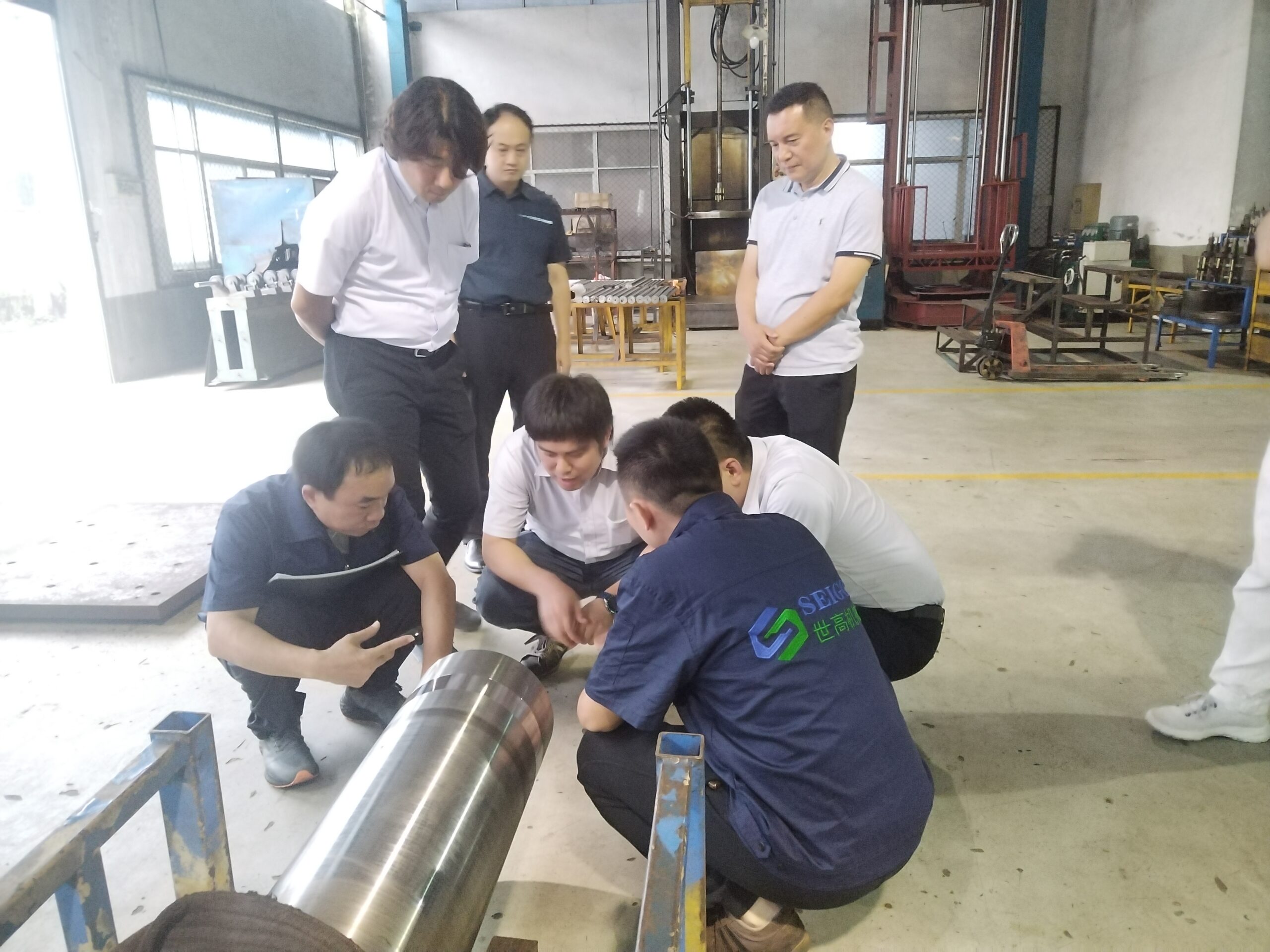
- OEM-grade quality credentials. ISO 9001 certified (IAF-verifiable), with documented OEM supply history including work for Yuchai Heavy Industry and supplier-audit visits hosted from Komatsu’s China engineering team.
- OEM-grade specifications on every cylinder. Rod chrome thickness ≥25 µm (≥30 µm for mining), surface roughness Ra ≤0.2 µm, honed 27SiMn or 45# cylinder tube, NOK (Japan) seal packages standard, 100% pressure testing at 1.5× working pressure with individual certificates.
- Cross-reference against any OEM part number — Caterpillar, Komatsu, Volvo, Hitachi, Doosan, Hyundai, John Deere, XCMG — returned within one business day with sealed mechanical drawing.
- Risk-controlled factory-direct terms. Standard 30/70 payment structure, Trade Assurance available, full Incoterms range including DDP that handles US tariff exposure inclusive in the landed-cost quote.
- 12-month warranty with documented claim resolution and return freight covered on confirmed manufacturing defects.
- Sample orders accommodated for new buyer relationships, allowing buyers to verify quality before committing to volume.
For fleet operators, distributors, and equipment dealers sourcing replacement cylinders on out-of-warranty heavy equipment, SEIGO’s position delivers the lowest-TCO channel — Tier 1 factory-direct — with the documentation and quality verification that lets a procurement team qualify the supplier confidently against the framework in this guide.
The right sourcing decision isn’t about finding the cheapest cylinder or the most expensive one. It’s about matching the channel to the situation and verifying quality regardless of channel. For most out-of-warranty heavy equipment, that decision points toward qualified factory-direct sourcing — and SEIGO is built to be exactly that qualified source.
Ready to compare factory-direct against your current sourcing?
Send your top replacement cylinder SKUs with OEM part numbers and machine models. SEIGO’s engineering team returns cross-reference confirmation, sealed drawings, and a factory-direct quote within one business day — so you can run the TCO comparison against your current costs.
Request a Factory-Direct Sourcing Quote → Download the SEIGO Cylinder Catalog (PDF) →
SEIGO Machinery Equipment Co. is an ISO 9001-certified manufacturer of hydraulic cylinders for excavators, wheel loaders, dump trucks, drill rigs, mining equipment, and industrial applications. Thirty years of OEM-grade manufacturing experience, monthly capacity exceeding 6,000 units, and engineering CAD turnaround within one business day. Factory-direct pricing for global distributors and equipment fleets.
Disclaimer: Caterpillar®, Komatsu®, Volvo®, Hitachi®, and all related manufacturer names are trademarks of their respective owners. SEIGO Machinery is not affiliated with, endorsed by, or sponsored by these companies. Pricing data and TCO figures reflect general market observations and may vary by region, application, and date. Buyers should verify specifications for their specific application.
Related Reading:
- Factory Direct Hydraulic Cylinder Procurement: 10 Questions to Ask Your Chinese Manufacturer
- Tariff Impact on Hydraulic Cylinder Procurement 2026: How US Buyers Can Protect Their Supply Chain
- CAT Excavator Hydraulic Cylinder Replacement Guide: OEM vs Aftermarket Comparison