A boom cylinder running on a construction-spec excavator at a suburban building site spends most of its working hours moving clean fill, occasionally hitting a rock, in temperate weather and reasonably clean air. A boom cylinder running on the same nominal duty class in an underground iron ore mine spends those same hours buried in abrasive ore dust, soaked in mine water with variable pH, exposed to vibration from blasting work happening half a kilometre away, and operating within a regulatory framework that treats every electrical and hydraulic component as a potential ignition source.
These two machines look similar from across a yard. Their hydraulic cylinder requirements are not the same — and treating them as the same is one of the more expensive procurement errors in mining operations. Standard construction-grade cylinders dropped into underground mining service typically fail at 30–50% of their construction-application service life. Premature seal failure, rod chrome corrosion, barrel erosion, and pin-end fatigue all show up faster than the OEM data sheet predicts because the data sheet was written for a different operating environment.
This guide breaks down what mining hydraulic cylinder specifications actually require — operating conditions that drive the design, certification requirements for underground service, the material and sealing choices that survive abrasive mining environments, and a procurement checklist for mining buyers sourcing replacement and custom cylinders.
The Underground Mining Environment: What Cylinders Actually Face
The operating environment for underground mining hydraulic cylinder applications differs from surface construction work across every variable that affects cylinder service life. Understanding the environment is the first step before any specification conversation makes sense.
Continuous abrasive exposure. Underground mining generates fine ore dust and rock particles continuously. The dust isn’t ambient — it’s airborne, settling on every machine surface within minutes of exposure. Hardrock mining (copper, gold, iron ore, platinum) produces silica-rich dust with hardness rating Mohs 6.5–7, harder than the chrome plating on a standard cylinder rod. Coal mining produces dust that’s softer but combustible. Either way, contamination ingress is constant, not occasional.
Water ingress with variable chemistry. Mine water isn’t process water. It contains dissolved minerals, often with pH ranging from acidic (1.5–4.0 in sulfide mining environments) to mildly alkaline. Direct exposure of rod chrome to acidic mine water accelerates corrosion underneath the chrome layer, lifting the plating and exposing the base steel within months of service. Standard chrome electroplating designed for ambient construction exposure isn’t designed for this chemistry.
Temperature ranges that test seal compounds. Underground temperatures vary dramatically by mine type. Deep gold mines in South Africa run ambient temperatures of 50–60°C at the working face. Underground iron ore mines in Northern Sweden operate at -20°C in winter. The hydraulic fluid itself runs hotter than ambient — typically 60–85°C in normal service, rising to 90–100°C during heavy continuous work. Standard NBR seals harden and crack under sustained operation above 80°C; the fluid temperature in normal mining service often exceeds the temperature rating of construction-grade seals.
High vibration and shock loading. Drilling work, blasting cycles, ore handling, and travel across uneven mine floors produce vibration levels and shock loads that exceed surface construction averages by a meaningful margin. Pin-end welds, rod-piston connections, and bushing interfaces accumulate fatigue cycles faster. A cylinder rated for 8,000 hours of construction service may see only 4,000–5,000 hours of mining service before fatigue-driven failure modes appear.
Restricted access and high removal cost. Removing a cylinder from a 200-ton mining excavator working underground isn’t comparable to changing one out on a 20-ton construction machine on a job site. The labor cost, lost production time, and logistics complexity of replacement work compound the importance of getting the cylinder right the first time. Mining maintenance budgets are heavily skewed toward replacement-on-failure rather than rebuild-in-place, which drives the specification logic toward premium cylinders that hit their full design life.
These five conditions — abrasion, water chemistry, temperature extremes, vibration, restricted access — define the operating envelope that any genuine mining hydraulic cylinder needs to be designed against. Cylinders sized correctly for the force requirement but built to construction-application material and sealing standards will not survive this environment, regardless of how impressive the load capacity number looks on paper.
Dust, Vibration, and Temperature: The Material Specifications That Matter
The operating environment translates directly into specific material and surface treatment requirements. The differences between mining-grade and construction-grade cylinders are visible on the spec sheet if anyone is paying attention.
Cylinder tube material. Mining hydraulic cylinder construction uses 27SiMn alloy steel (Chinese designation, equivalent to ISO/JIS S45CrMnNi grades) for the cylinder barrel — a chromium-manganese-silicon alloy with higher yield strength (typically 825 MPa minimum) and superior fatigue resistance compared to standard 45# carbon steel used in construction-grade work. The tube is honed to a tighter inside-diameter tolerance (H7 standard for mining vs H8 for construction) with surface roughness Ra ≤0.4 µm.
Rod material and surface treatment. Standard chrome electroplating with thickness around 20–25 µm is adequate for general construction service. Mining service demands more. Rod chrome thickness of 30 µm minimum is the entry baseline for mining cylinders, with severe-duty applications running 40–50 µm. Surface roughness on the rod is held to Ra ≤0.2 µm. Where mine water chemistry is particularly aggressive, nickel-chrome duplex plating (nickel underlayer followed by hard chrome) extends service life significantly versus single-layer chrome by providing a corrosion barrier underneath the chrome that resists the undercutting failure mode common in acidic mine environments.
Induction-hardened rod option. For extreme abrasion environments, induction-hardened piston rods (surface hardness HRC 56–60) provide a wear-resistant surface that doesn’t depend on plating integrity. The trade-off is higher base cost and longer manufacturing lead time, but in iron ore and copper concentrate handling applications, induction hardening can double rod service life versus chrome-plated alternatives.
Wall thickness and safety factor. Mining cylinders are typically built with thicker barrel walls and higher safety factors than equivalent-force construction cylinders. Where construction cylinders run a 1.5× working pressure safety factor as standard, mining-class cylinders run 2.0–2.5× safety factor to absorb shock loading, transient pressure spikes from blasting work transmitted through the hydraulic circuit, and fatigue accumulation from continuous heavy duty.
Pin-end construction. The cylinder mounting interfaces — clevis ears, pin eyes, trunnion mounts — see the brunt of vibration and shock loading. Mining-spec cylinders use forged pin-end housings rather than welded assemblies wherever possible, with through-hardened bushings sized for higher PV (pressure × velocity) loading than construction equivalents.
These differences aren’t marketing language. They’re verifiable through metallurgical test reports, chrome thickness measurements, and dimensional inspection. A supplier quoting “mining-grade cylinders” without being able to produce the test data isn’t quoting mining-grade cylinders.
When Explosion-Proof Certification Matters (And When It Doesn’t)
The question of certification requirements for underground mining hydraulic cylinder applications causes more confusion than almost any other procurement question. The clarification is worth getting right because it changes both cost and lead time significantly.
The basics of underground mining certification. Underground coal mines in the United States operate under MSHA (Mine Safety and Health Administration) regulations, specifically 30 CFR Part 18 for electrical equipment and 30 CFR Part 35 for hydraulic fluids. European underground mines operate under ATEX directives (94/9/EC) with IEC 60079 standards for explosion-protected equipment. The Australian standard is AS/NZS 60079; South African mines use SANS standards aligned with IEC.
What requires explosion-proof certification. Electrical equipment, motors, control systems, and components that could create ignition sources require certified explosion-proof or intrinsically safe ratings for service in gassy underground coal mines or sulfide ore mines with explosive atmospheres. This includes electric motors driving hydraulic pumps, control valves with electrical solenoids, and instrumentation.
What doesn’t typically require explosion-proof certification. Standard hydraulic cylinders without integrated electrical components don’t fall under explosion-proof certification requirements directly. A cylinder is a passive mechanical component; it doesn’t generate ignition sources. The certification burden falls on the integrated equipment (the loader, the continuous miner, the LHD vehicle) rather than on the cylinder itself.
Where the certification conversation actually matters for cylinders. Two specific areas:
- Hydraulic fluid certification under MSHA 30 CFR Part 35 — fire-resistant hydraulic fluids must meet autoignition temperature and spray ignition test requirements. The cylinder seal package must be compatible with these fluids (water-glycol, water-in-oil emulsion, or phosphate ester) without degradation. Standard NBR seals are not compatible with phosphate ester fluids; FKM (Viton) is required.
- Load locking valves on hydraulic cylinders supporting cutting heads on continuous miners and loading machines — MSHA 30 CFR Part 18 requires hydraulic load locking valves meeting specific MSHA criteria for these specific applications. The valve is the regulated component; the cylinder must be compatible with the locking valve integration.
For most surface mining and open-pit mining hydraulic cylinder applications — Komatsu PC2000, CAT 6020, Liebherr R 996 — explosion-proof certification simply doesn’t apply. The certification conversation is relevant primarily for underground coal mining and specific underground hardrock applications where methane or hydrogen sulfide may be present.
A supplier quoting unnecessary explosion-proof certification “just to be safe” is either uninformed about the regulatory framework or padding the quote. Procurement teams should be clear about the specific application before accepting certification cost loading that may not be required.
Case Study: Komatsu PC2000 Mining Excavator Cylinders
The Komatsu PC2000 platform — currently produced as the PC2000-11 with the prior PC2000-8 still in heavy active service — is one of the most-deployed large mining excavators in global hardrock and coal surface mining operations. The cylinder specifications offer a useful concrete example of what mining-class hydraulic cylinder geometry actually looks like.
Confirmed PC2000-11 cylinder specifications (per Komatsu official documentation):
| Cylinder Position | Quantity | Bore × Stroke |
|---|---|---|
| Backhoe Boom Cylinder | 2 | 11.8″ (300 mm) × 104.2″ (2,647 mm) |
| Backhoe Arm Cylinder | 2 | 9.8″ (249 mm) × 84.2″ (2,139 mm) |
| Backhoe Bucket Cylinder | 2 | 7.9″ (200 mm) × 85.4″ (2,169 mm) |
System pressure specifications:
- Backhoe (implement) circuit: 4,270 PSI (29.4 MPa)
- Travel circuit: 4,760 PSI (32.8 MPa)
- Swing circuit: 4,270 PSI (29.4 MPa)
- Pilot circuit: 464 PSI (3.2 MPa)
Machine context:
- Operating weight: ~200 metric tons (PC2000-8) / 201.9 metric tons (PC2000-11)
- Bucket capacity: 12.0 m³ / 15.7 yd³ standard
- Tear-out force: 626 kN
- Engine: Komatsu SAA12V140E-7, U.S. EPA Tier 4 Final certified (PC2000-11)
- Hydraulic tank capacity: 1,300 L
The cylinder geometry reflects the mining application directly. The 300 mm bore boom cylinder is substantially larger than equivalent positions on construction excavators (Komatsu PC200 boom runs 130 mm bore; PC300 runs 140 mm bore) — the PC2000 is essentially in a different category, sized for production mining shovel duty rather than construction earthmoving.
Notable Komatsu engineering attention to mining duty on the PC2000 platform includes “new sealing package on work equipment cylinders to withstand the most abrasive applications” per the official PC2000-11 specifications. This explicit recognition of the abrasive environment translates into the seal and rod surface treatment specifications discussed above.
Replacement cylinders for the PC2000 platform are a meaningful aftermarket category given the installed base. Mining hydraulic cylinder manufacturers serving this market need to match not just the dimensional specifications but the material and surface treatment standards Komatsu engineered for the mining-grade application — not the construction-grade equivalents that would be acceptable on a PC200 platform.
Seal Material Selection for Mining Service
The seal package choice is where mining hydraulic cylinder specifications diverge most sharply from construction defaults. Standard seal materials don’t survive the temperature, fluid, and contamination conditions encountered in serious mining service.
Standard NBR (nitrile) seals are the construction-grade default. Temperature range -40°C to +100°C, compatible with mineral hydraulic oil. NBR is genuinely fine for most surface construction work but reaches end of life faster under sustained 80°C+ operation typical in mining duty cycles. Not appropriate for fire-resistant hydraulic fluids.
FKM (Viton) fluoroelastomer is the mining standard for severe-duty applications. Temperature range -20°C to +200°C, compatible with phosphate ester fluids, water-glycol fluids, and high-temperature mineral oils. Significantly higher cost than NBR — typically 3–4× the seal kit price — but the service life in mining environments is 2–3× longer. For fire-resistant hydraulic fluid systems mandated by MSHA in underground coal mining, FKM is not optional.
HNBR (hydrogenated nitrile) sits between NBR and FKM. Temperature range -30°C to +150°C, better chemical resistance than NBR, lower cost than FKM. Suitable for mining applications operating with hot mineral oil but not phosphate ester fluids. Increasingly common as a middle-ground specification for mining buyers wanting better temperature tolerance without paying full FKM premium.
Polyurethane (PU) seals handle high pressure (>35 MPa) and provide excellent wear resistance under abrasive contamination loads. PU is particularly common in piston-side and rod-side primary seals in mining cylinders, with NBR or FKM static seals elsewhere in the same cylinder. The composite seal package is the practical reality of mining-grade design.
PTFE-based bonded seals are used for rod-side wiper and bearing applications where low friction and high temperature tolerance matter more than primary sealing function. PTFE filled with carbon, glass, or bronze adjusts the wear and friction characteristics for the specific application.
The premium specification for a serious underground mining hydraulic cylinder typically combines: NOK (Japan) or Parker Prädifa (Germany) primary seal package using FKM material, polyurethane secondary seals on critical sealing positions, bronze-filled PTFE rod wiper, and bronze-backed PTFE bearing strips. The seal package alone on a properly-built mining cylinder can run $400–$900 at premium vendor pricing — meaningful budget, but a fraction of the cost of cylinder replacement-on-failure.
Procurement Checklist for Mining Cylinder Buyers
The specification framework for mining hydraulic cylinder procurement should answer the following questions before any quote is accepted:
Operating environment:
- Underground coal, underground hardrock, or surface mining?
- Continuous water exposure, intermittent exposure, or dry environment?
- Approximate ambient temperature range?
- Hydraulic fluid type (mineral oil, fire-resistant water-glycol, phosphate ester)?
Mechanical requirements:
- Working pressure (specify whether implement circuit, travel circuit, or other)
- Required force (extension and retraction)
- Stroke length
- Mounting configuration (clevis, trunnion, flange)
- Pin diameter and pin-eye dimensions
Material specifications to confirm:
- Cylinder tube: 27SiMn or equivalent (specify if H7 ID tolerance required)
- Rod surface treatment: chrome thickness ≥30 µm for general mining, ≥40 µm for severe-duty
- Rod surface roughness: Ra ≤0.2 µm
- Optional nickel-chrome duplex plating for acidic mine water exposure
- Optional induction hardening for high-abrasion service
Seal package specifications:
- Primary seal material (specify FKM if required by fluid compatibility)
- Specific seal vendor (NOK Japan or Parker Prädifa as premium specifications)
- Temperature rating
- Wiper and bearing material
Quality verification:
- 100% pressure testing at 1.5× working pressure
- Individual pressure test certificate with each cylinder
- Metallurgical test report on cylinder tube and rod material on request
- Chrome thickness measurement records
- ISO 9001 certification documentation
Certification (where applicable):
- MSHA 30 CFR Part 35 hydraulic fluid compatibility documentation if cylinder will operate with approved fire-resistant fluids
- ATEX compliance documentation for European underground service if integrated equipment requires it
- Load locking valve compatibility for MSHA-approved continuous miner and loading machine applications
Commercial considerations:
- Lead time (mining cylinders typically run 45–60 days due to higher material specifications and additional testing)
- Warranty (12-month minimum, 18-month preferred for mining-class cylinders given replacement cost)
- Delivery terms (DDP often appropriate for mining buyers to simplify customs and reduce logistics burden)
- Return and warranty claim process documentation
This checklist transforms the mining cylinder procurement conversation from a price comparison into a specification dialogue. Quality manufacturers welcome detailed specification work because it allows them to differentiate from generic suppliers; suppliers who can’t engage with this level of detail are usually quoting construction-grade product against mining-class requirements.
SEIGO Mining Hydraulic Cylinder Capabilities
SEIGO Machinery manufactures hydraulic cylinders for underground and surface mining applications across the full size range from medium mining excavators (Komatsu PC450 / CAT 390 class) up through large mining shovels and dragline boom cylinders. Mining-class production runs the upgraded specifications described above:
- Cylinder tube: 27SiMn alloy steel, honed to H7 ID tolerance with Ra ≤0.4 µm surface roughness
- Rod surface treatment: Hard chrome ≥30 µm minimum for mining applications, ≥40 µm for severe-duty; nickel-chrome duplex plating available for acidic mine water exposure; induction-hardened rods available for high-abrasion applications
- Seal package: NOK (Japan) FKM seals standard for mining specification, Parker Prädifa available for severe-duty applications; polyurethane primary seals where pressure and wear demand it
- Pressure rating: Working pressures up to 50 MPa available; 2.0–2.5× safety factor on mining-class production
- Testing: 100% pressure testing at 1.5× working pressure with individual certificates; metallurgical and chrome thickness verification available on request
- Capacity: Monthly production exceeding 6,000 units across all cylinder categories with dedicated mining-class production track
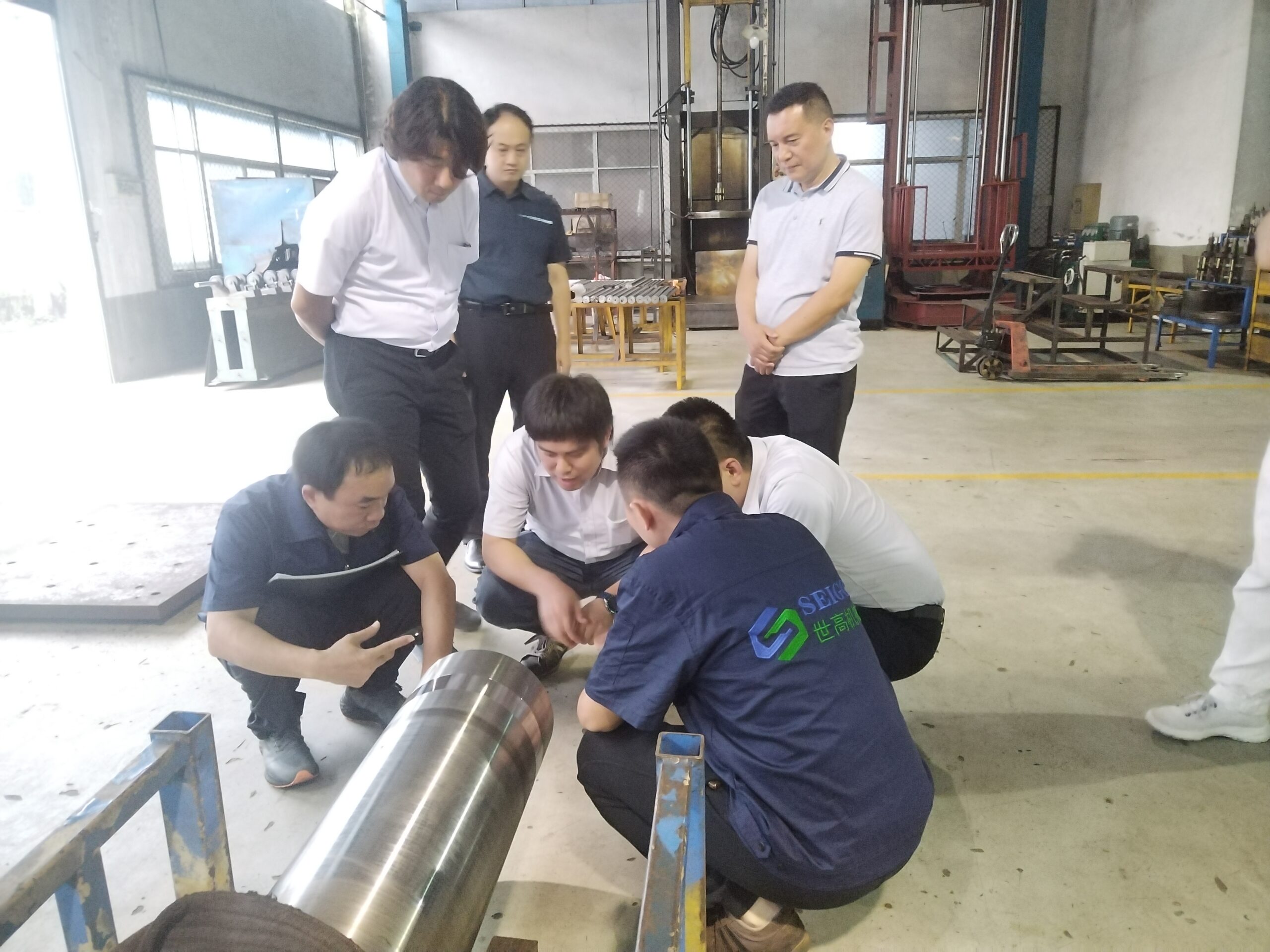
- Documentation: ISO 9001 certification, MSHA-compatible documentation for fluid compatibility on request, OEM audit history including supplier visits from Komatsu’s China engineering team
For mining operations sourcing replacement cylinders on Komatsu PC2000, PC3000, PC4000, and PC5500 mining excavators — or on CAT 6020, 6030, and 6040 mining shovel platforms — SEIGO’s mining-class aftermarket program delivers OEM-grade specifications with factory-direct pricing and engineering documentation available for buyer verification.
Sourcing replacement cylinders for mining-class equipment?
Send the OEM part number, machine model, and operating environment details. SEIGO’s engineering team returns a sealed mechanical drawing with mining-class material specifications and factory-direct quote within one business day.
Request a Mining Cylinder Quote → Download the SEIGO Cylinder Catalog (PDF) →
SEIGO Machinery Equipment Co. is an ISO 9001-certified manufacturer of hydraulic cylinders for mining excavators, construction equipment, drill rigs, and industrial applications. Thirty years of OEM-grade manufacturing experience, monthly capacity exceeding 6,000 units, and engineering CAD turnaround within one business day. Factory-direct pricing for global mining operations and equipment fleets.
Disclaimer: Komatsu®, Caterpillar®, CAT®, Liebherr® and all related model designations are trademarks of their respective manufacturers. SEIGO Machinery is not affiliated with, endorsed by, or sponsored by these companies. Model designations are referenced for cross-reference identification only. Regulatory references to MSHA 30 CFR Parts 18 and 35 and IEC 60079 / ATEX standards are summarized for general guidance — buyers and operators should consult current official regulatory documentation and licensed compliance professionals for application-specific requirements.
Related Reading:
- Komatsu PC200/PC300 Hydraulic Cylinder Specs & Replacement Guide
- Tie Rod vs Welded Hydraulic Cylinders: Which Is Right for Your Heavy Equipment?
- The Complete Guide to Hydraulic Cylinder Sizing: How to Calculate Force, Speed & Stroke for Excavators