Get a hydraulic cylinder sized wrong, and you’ll find out fast.
Maybe the boom can’t lift a half-loaded bucket on the first cycle of the morning. Maybe the rod buckles under side load after 800 hours. Or maybe everything works fine — until your operator pushes through dense clay and a seal blows because the pressure spike pushed past what the cylinder was rated for.
I’ve sat in on cylinder failure reviews for the better part of two decades. Roughly half of what we see traces back to one root cause: somebody got the sizing wrong at the front end. Not the manufacturing. Not the seals. The math.
This hydraulic cylinder sizing guide is written for procurement engineers, fleet maintenance leads, and OEM designers who need to specify (or replace) excavator hydraulic cylinder units — from 1.7-ton compact machines up to 100-ton mining shovels. We’ll walk through the parameters, the actual hydraulic cylinder force calculation formulas, and the mistakes that quietly drain real money out of a budget.
Why Proper Sizing Matters More Than You’d Think
Here’s a number that genuinely surprised me when we first crunched the data: in a sample of 312 premature cylinder failures we logged between 2022 and 2024, 47% had design or sizing issues as a contributing root cause. Not seal wear. Not contamination. Sizing.
What does “sized wrong” actually look like in the field?
- A 320-class boom cylinder undersized for a heavier-than-spec stick attachment. Operator complains about sluggish lift cycles. The pressure relief valve cycles constantly. Within 14 months, you’ve resealed it twice.
- A retrofit telescopic on a dump body that’s right on force but wrong on stroke. It bottoms out hard every cycle. Rod-end weld cracks at around 1,800 hours.
- A bucket cylinder rated at 35 MPa working pressure — but the new high-flow attachment runs the circuit at 38 MPa. Nobody caught the mismatch. Three weeks in, the rod chrome starts flaking.
None of these are exotic problems. They happen because someone treated cylinder sizing as a parts-bin exercise instead of an engineering decision.
The flip side is also true. Oversize a cylinder and you’re paying for steel you’ll never use, adding weight that hurts cycle time and fuel burn, and probably overworking the pump downstream. There’s a real cost to “just spec the bigger one.”
The Four Numbers You Need Before Anything Else
Before you can calculate a thing, you need four parameters. Get these wrong and the rest of the math is decorative.
Bore diameter (D) — the inside diameter of the cylinder tube. This is what determines extension force at any given pressure. Most mid-size excavator boom cylinders run between 100 mm and 160 mm bore. Mining-class machines? 200 mm and up.
Rod diameter (d) — the outside diameter of the piston rod. Rod size matters more than most people realize. It controls retraction force, sets the column-buckling limit, and largely determines side-load tolerance. Common rod-to-bore ratios sit between 0.5 and 0.7. A Komatsu PC200 boom cylinder, for instance, typically runs around 140 mm bore × 95 mm rod — a 0.68 ratio.
Working pressure (P) — what the system actually runs at, not just the nameplate value. There’s a difference. Most modern excavators run system pressure between 30 and 38 MPa (4,350 – 5,500 psi), with momentary peaks during heavy digging that can hit 41 MPa. You size for the working pressure, then build in safety margin. We’ll get to that.
Stroke length (L) — how far the rod extends from fully retracted to fully extended. Stroke determines reach, dump angle, dig depth — all the geometry of what the machine can actually do. It’s also the parameter most often “borrowed” from the original spec without verification, which is exactly how you end up with replacement cylinders that don’t quite fit.
There’s a fifth number that doesn’t always get its own line on a spec sheet but absolutely should: the operating environment. Temperature range, contamination class, side-load profile, mounting style. These don’t change the basic math, but they shift your safety factors and material choices significantly. A cylinder destined for an Inner Mongolia mining site shouldn’t be specified the same way as one going on a road grader in Florida.
Force Calculation: The Formulas That Actually Matter
The hydraulic cylinder force calculation isn’t complicated. Pressure × area = force. The trick is remembering that extension and retraction give you different effective areas, which means different output forces from the same cylinder at the same pressure.
Extension Force
When the rod is being pushed out, hydraulic fluid acts on the full piston face:
F_extend = P × π × D² / 4
Quick sanity check with real numbers. Take that PC200 boom cylinder running at 35 MPa with a 140 mm bore:
F = 35 × π × (140)² / 4 F = 35 × π × 19,600 / 4 F ≈ 538,800 N ≈ 54.9 metric tons
That’s the theoretical maximum. In practice, knock 5 – 10% off for friction losses (seal drag, bearing friction, port restriction). Usable force lands closer to 50 metric tons. That number — usable force — is what should match your application requirement, not the headline number.
Retraction Force
When the rod is pulling back, the rod itself takes up part of the piston area, so the effective working surface drops:
F_retract = P × π × (D² − d²) / 4
Same PC200 cylinder, 140 mm bore × 95 mm rod, at 35 MPa:
F = 35 × π × (140² − 95²) / 4 F = 35 × π × (19,600 − 9,025) / 4 F ≈ 290,500 N ≈ 29.6 metric tons
Notice that retraction force is roughly 54% of extension force. That’s typical, and it’s exactly why excavator boom cylinders extend to lift loads (the heavy-duty stroke) and retract under their own weight or much smaller forces. The geometry is doing the engineering work for you — as long as you set it up right.
If you ever spec a cylinder where retraction is the working stroke (think hold-down or clamping applications), you’ll need to either run higher pressure or use a bigger bore to compensate. People forget this when adapting cylinder designs across applications, and it costs them.
Speed Calculation: Will It Move Fast Enough?
Force tells you whether the cylinder can do the work. Speed tells you whether it can do the work fast enough to be useful. Slow cylinders kill productivity even when they have plenty of force on paper.
Extension Speed
v_extend = Q / (π × D² / 4)
Where Q is flow rate from your pump (in m³/s for SI, or L/min if you prefer practical units).
Real example: a PC200-class machine pump delivers around 220 L/min to the boom circuit at full flow. With our 140 mm bore:
v = (220 ÷ 60,000) m³/s ÷ (π × 0.140² / 4) v ≈ 0.00367 ÷ 0.01539 v ≈ 0.238 m/s
That’s about 240 mm per second. For a typical boom stroke around 1,400 mm, full extension takes roughly 5.9 seconds. Sounds about right — operators on that class of machine expect a sub-6-second boom raise.
Retraction Speed
Because the rod displaces internal volume, retraction is faster than extension at the same flow rate:
v_retract = Q / (π × (D² − d²) / 4)
Plug the same numbers in and retraction speed comes out at roughly 0.44 m/s — almost twice as fast as extension. This is normal. Operators want quick repositioning between cycles, and the geometry gives it to them for free.
But it also means regen cavitation is a real risk on long retraction strokes if the rod-side return circuit can’t handle the flow. If you’re sizing an unusually long-stroke cylinder — long telescopics, mast cylinders on drill rigs — this is the kind of side issue that bites you in the field but never appears in the basic force math.
Safety Factor Selection: Where Engineering Judgment Replaces Formulas
This is where the conversation gets fuzzy. Standard practice on general construction equipment is a 1.5× safety factor on theoretical force. So if your application needs 30 metric tons of pull, you size for 45 tons of theoretical capacity at working pressure.
But “1.5×” is a starting point, not a rule.
| Application Type | Recommended Safety Factor |
|---|---|
| Standard construction excavator | 1.5× |
| Mining / quarry duty | 2.0× – 2.5× |
| Demolition / shock loading | 2.5× – 3.0× |
| Heavy industrial press | 3.0× and up |
| Marine / offshore | 2.0× minimum, often more |
The safety factor isn’t padding for incompetence. It’s covering things that don’t show up in the basic equation: pressure spikes, dynamic side loads, thermal expansion, fatigue cycling, and the gap between nameplate pressure and what the system actually does under transient conditions.
A common mistake I’ve seen on procurement specs is buying mining hydraulic cylinder units sized at 1.5× because that’s what the construction-grade spec sheet recommended. They fail. Not because they were poorly built — because they were sized as if mining is just construction with bigger machines. It isn’t. The duty cycle, shock loading, and contamination exposure are categorically different problems.
Five Sizing Mistakes That Show Up Again and Again
After enough field reviews, the same patterns keep coming back:
Mistake 1 — Sizing for nameplate pressure instead of true working pressure. Some excavators have power-boost modes that bump pressure 10 – 15% above the standard rating for a few seconds during heavy digging. If your cylinder is sized for the lower nameplate number, you’re operating at margin during the most demanding part of every cycle. Over thousands of cycles, that margin disappears.
Mistake 2 — Ignoring rod buckling on long-stroke cylinders. When the cylinder is fully extended and pushing, the rod is essentially a long column under compressive load. Euler’s buckling formula applies. For strokes longer than about 8× the rod diameter, you need to verify column stability — not just force capacity. Plenty of cylinders have plenty of force on paper and still fail because the rod isn’t stiff enough at full extension.
Mistake 3 — Skipping stroke verification on replacements. The OEM stroke might be 1,420 mm. The replacement cylinder you’re considering shows 1,400 mm. Twenty millimeters doesn’t sound like much. Until your bucket can’t curl all the way and you’ve left dig performance on the table on every single cycle, every single day.
Mistake 4 — Mounting style mismatch. A correctly-sized cylinder using pin-eye mounting where the application calls for a clevis-trunnion combo will see side loads it wasn’t designed for. Bushings wear out fast. Bores oval-out. And now you’re chasing a problem that started as a mounting error, not a sizing error — but the cost lands in the same column.
Mistake 5 — Forgetting the duty cycle math. “It needs to lift 5 tons” is a different problem than “it needs to lift 5 tons every 12 seconds for 10 hours a day.” The second case is a fatigue problem. Your cylinder won’t fail from a single overload — it’ll fail from accumulated cycles at high stress. This is where the difference between premium aftermarket and commodity-grade replacement cylinders shows up most clearly: in seal life and rod surface integrity over millions of cycles.
A Note on Custom Engineering and Why It Pays Off
Most off-the-shelf replacement cylinders work fine when the application matches the original spec. But replacements aren’t always one-to-one. Maybe you’re upgrading to a heavier bucket. Maybe your machine runs a non-standard hydraulic schedule. Maybe the original cylinder was the failure point and you don’t want to repeat the same design.
This is where custom engineering earns its keep.
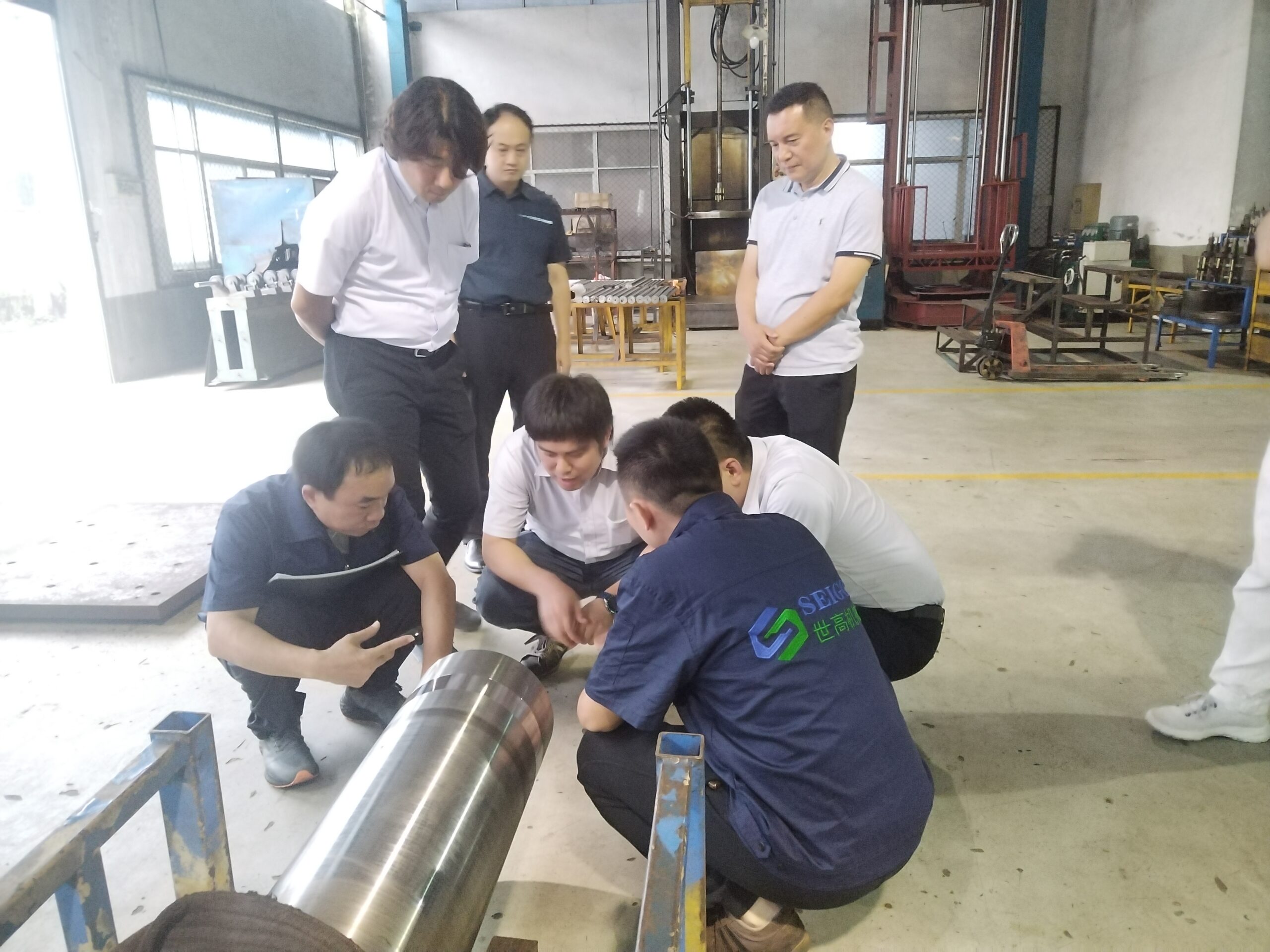
At SEIGO, we run customer drawings or sample units through full CAD review within 24 hours — including bore-to-rod optimization, mounting compatibility verification, and pressure-class confirmation. The output is a sealed drawing you can sign off on, not a quote based on the closest standard size in the catalog. For mining hydraulic cylinder builds specifically, we run tighter chrome thickness (>30 μm) and pressure-test every unit at 105% of rated working pressure before it ships.
If you just need to verify whether a replacement cylinder actually matches your application, sending us the OEM part number plus the machine model and serial range is usually enough. Cross-reference comes back same business day for most active production lines.
Putting It All Together
Sizing a hydraulic cylinder isn’t black magic, but it’s not a lookup table either. The basic math is straightforward — pressure, area, force, flow, speed. The engineering judgment around safety factors, duty cycle, and operating environment is where the real value lives. Two cylinders that look identical on the spec sheet can have wildly different field performance depending on whether someone actually sized them for the work they’re going to do.
If you’re buying replacements: don’t just match the OEM number. Verify that the working conditions are still what they were when the cylinder was originally specified. Equipment gets used in ways the original designer never anticipated.
If you’re designing new: have the safety factor conversation early. It’s cheaper than warranty claims and a lot cheaper than downtime.
And if you’re stuck on a sizing decision and want a second opinion from people who’ve built tens of thousands of these for excavators, loaders, dump trucks, and mining equipment — that’s what our engineering team is here for. No charge for the cross-reference. Quote within 24 hours.
Need a custom hydraulic cylinder sized for your application?
Send us your machine model, working pressure, and target force. Our engineers will turn around a complete spec sheet and CAD drawing within one business day.
Get a Custom Quote → Download Our Cylinder Catalog (PDF) →
SEIGO Machinery Equipment Co. is an ISO 9001-certified manufacturer of hydraulic cylinders for excavators, loaders, dump trucks, drill rigs, and industrial applications. With 30 years of OEM-grade manufacturing experience and a monthly capacity of 6,000+ units, we serve global distributors and equipment fleets with factory-direct pricing.
Related Reading:
- Excavator Hydraulic Cylinder Failure: How to Diagnose, Repair, and Source the Right Replacement
- Top 5 Hydraulic Cylinder Gland Types You Need to Know
- How to Source Mining-Grade Hydraulic Cylinders: A Technical Procurement Guide