Nearly every hydraulic cylinder manufacturer in the global market displays an ISO 9001 badge somewhere on their website. The certification has become so ubiquitous in B2B manufacturing that buyers often treat it as a binary checkbox — certified means good, not certified means avoid — and move on to price comparison.
That reading gets the certification badly wrong in both directions. ISO 9001 certifies considerably less than most buyers assume, and it also delivers something more useful than most buyers realize. Understanding exactly where that line sits is what makes the certificate worth anything in a procurement decision. Because here’s the thing that catches buyers off guard: ISO 9001 certifies the system that makes the parts — never the parts themselves.
This guide breaks down what ISO 9001 actually requires of a hydraulic cylinder manufacturer, how to verify a certificate is genuine (a real problem in this market), what to check during a factory audit, which supplementary certifications matter, and how to negotiate warranty terms that protect the buyer regardless of what certificates are on the wall.
What ISO 9001:2015 Actually Requires
ISO 9001:2015 is a quality management system standard. An accredited third-party auditor certifies that a manufacturer controls its documents, calibrates its instruments, traces its materials, and corrects its failures in a disciplined, repeatable way. The current edition is ISO 9001:2015 with Amendment 1:2024 (climate action), with a revised edition in preparation.
The auditable content sits in Clauses 4 through 10:
Clause 4 — Context of the organization. The manufacturer must determine its operating context, identify interested parties, and define the scope of its quality management system, including the processes needed and how they interact.
Clause 5 — Leadership. Top management must demonstrate commitment, establish a quality policy, and assign clear roles and responsibilities for quality outcomes.
Clause 6 — Planning. The manufacturer must identify risks and opportunities, plan actions to address them, set measurable quality objectives, and plan for changes.
Clause 7 — Support. Covers resources, personnel competence, awareness, communication, and documented information. Notably, the 2015 edition deliberately gives organizations freedom over the form and extent of documentation rather than mandating a quality manual or specific procedures. Employees should know the quality policy, their responsibilities, and how their work affects quality.
Clause 8 — Operation. This is the clause that matters most for a cylinder buyer. It covers customer requirement review, product planning, design and development, supplier control, production and service delivery, quality checking, identification and traceability, and control of nonconforming output. For a hydraulic cylinder manufacturer, Clause 8 is where material traceability, in-process inspection, and defect handling live.
Clause 9 — Performance evaluation. The manufacturer must monitor, measure, analyze, and evaluate QMS performance, including supplier performance review and management review.
Clause 10 — Improvement. Nonconformity handling, corrective action, and continual improvement of the system.
What ISO 9001 does NOT cover. This is the critical boundary. ISO 9001 does not certify that any specific cylinder meets your drawing. It doesn’t define your tolerances, your materials, your surface finish requirements, or your inspection level — those come from your specification and purchase order. It doesn’t require full dimensional reports on every lot unless you specify that. And it doesn’t guarantee product quality; it certifies that the shop has a disciplined system for producing consistent results against whatever specification it’s working to.
The practical implication for hydraulic cylinder procurement: ISO 9001 tells you the manufacturer has a functioning quality system. Your drawing, your specification, and your incoming inspection tell you whether the cylinder is right. Both matter, and neither substitutes for the other.
How to Verify an ISO 9001 Certificate Is Genuine
Fake and unaccredited ISO certificates are a real problem in global manufacturing sourcing, and the hydraulic cylinder market is no exception. A certificate PDF on a supplier’s website proves nothing by itself.
The three-step verification process:
Step 1 — Read the certificate properly. A legitimate certificate includes: the certification body’s name, a certificate number, an issue date, an expiration date (typically three years from issue), and — most importantly — a scope statement that specifies exactly what is certified. A real scope statement reads like “ISO 9001:2015 for the design and manufacture of hydraulic cylinders.” A vague scope like “ISO 9001 certification” or a scope covering only “metal products” without naming hydraulic cylinder manufacturing is a warning sign.
Step 2 — Verify the certification body is IAF-accredited. The certificate should carry the accreditation body’s logo, and often the International Accreditation Forum (IAF) mark. A certificate from an unaccredited “certification body” is worthless for any serious procurement qualification, regardless of how official the document looks.
Step 3 — Search IAF CertSearch. The International Accreditation Forum operates a global public register at iafcertsearch.org (launched in 2020) where accredited management system certificates can be verified by company name or certificate number. A genuine certificate appears in this database with confirmed validity status. A certificate that doesn’t appear in IAF CertSearch — and whose certification body isn’t listed as accredited — isn’t a certification. It’s marketing material. Note that the database has daily search limits and requires registration beyond a threshold.
Visual red flags worth knowing:
- Certificate numbers that don’t follow standard formats. Accredited certification bodies use specific numbering systems. Random-looking or simple sequential numbers often indicate forgeries.
- Vague or missing scope statements. As noted above, legitimate certificates specify exactly what’s certified.
- Certification body not listed on any accreditation register. Search the certification body’s own website for the certified company. If the manufacturer claims certification by a body but doesn’t appear on that body’s register, that’s definitive.
The consequences of accepting a fake certificate aren’t hypothetical. Documented cases include manufacturers losing large contracts when tender evaluators verified certificates against IAF CertSearch and found the issuing body had no accreditation, and Tier-1 contractors terminating supplier agreements immediately upon discovering certificates came from unaccredited bodies operating without site visits.
Factory Audit: What to Actually Check
ISO 9001 certification verifies the system exists. A factory audit verifies the system is actually running and that the factory can produce what it’s quoting. For meaningful hydraulic cylinder procurement, the audit matters as much as the certificate.
Audit cost reality (2026 pricing):
| Audit Type | Typical Cost | Duration |
|---|---|---|
| Basic supplier verification (regional firm) | $200–$500 | 1 day |
| Full technical quality audit | $400–$1,000 | 1–2 days |
| SGS / Bureau Veritas / Intertek audit | $600–$1,500+ | 1–2 days |
| Social compliance audit (separate) | $1,000–$2,500 | 1–2 days |
Against a container order that might represent $40,000–$80,000 in value, a $600–$1,200 audit is inexpensive insurance.
Hydraulic-cylinder-specific audit checkpoints:
Manufacturing capability:
- Honing machines with capacity matching the bore sizes quoted (an inspector should verify machine capacity against the largest cylinder in the quote)
- CNC machining capability for rod ends, gland housings, and pin eyes
- Chrome plating line — in-house or subcontracted (subcontracted is normal; the question is whether the subcontractor is controlled under Clause 8 supplier control)
- Welding capability and welder qualification records for welded cylinder construction
- Assembly area cleanliness — hydraulic assembly in a contaminated environment produces contaminated cylinders
Quality control infrastructure:
- Calibrated measuring equipment with current calibration records (bore gauges, micrometers, surface roughness testers)
- Chrome thickness measurement capability — this is the specification most often claimed and least often verified
- Surface roughness (Ra) measurement equipment
- Pressure test rig with capacity to test at 1.5× the working pressure of the largest cylinder produced
- Material certificate filing system demonstrating traceability from steel supplier to finished cylinder
Process documentation:
- In-process inspection records, not just final inspection
- Nonconforming product handling procedure with actual records of recent nonconformities and their disposition (a factory with zero recorded nonconformities is either not recording them or not finding them — both are problems)
- Corrective action records showing the improvement loop actually functions
The test that separates real from theatrical. Ask to see the last three nonconformity reports and their corrective actions. A functioning quality system produces these regularly and handles them systematically. A factory that can’t produce recent nonconformity records is running the paperwork without running the system.
Supplementary Certifications and Third-Party Inspection
ISO 9001 is the foundation. Several supplementary certifications and services add specific value for hydraulic cylinder buyers.
IATF 16949 builds on ISO 9001 for automotive and EV supply chains, requiring PPAP (Production Part Approval Process), APQP, FMEA, MSA, and statistical process controls aligned to customer-specific requirements. A hydraulic cylinder manufacturer holding IATF 16949 is operating at a meaningfully higher documentation and process-control standard than ISO 9001 alone requires. Not necessary for most construction equipment cylinder procurement, but a strong positive signal.
ISO 14001 (environmental management) and ISO 45001 (occupational health and safety) indicate broader management system maturity. Not directly quality-related but correlated with organizational discipline.
CE marking for European market shipments and RoHS compliance documentation where applicable.
Third-party inspection services are the practical complement to certification. Rather than relying solely on the manufacturer’s own quality system, buyers can commission independent verification:
| Service | Typical Cost | What It Covers |
|---|---|---|
| Pre-shipment inspection (PSI) | $200–$450/man-day | Final quality check before shipping |
| During-production inspection | $250–$500/man-day | Mid-production correction opportunity |
| Container loading supervision | $200–$350/shift | Verifying shipment accuracy and packing |
The major international inspection companies — SGS, Bureau Veritas, Intertek, TÜV — all provide reliable standardized service with globally recognized reports. SGS carries the most brand recognition globally; Bureau Veritas offers broader certification capabilities if compliance testing is needed alongside inspection. Regional and specialist firms (QIMA, V-Trust, and others) typically price lower at $150–$350 per man-day with comparable service quality for straightforward inspection work.
Why the report source matters. A signed report from an accredited international inspection company carries significant weight as documented evidence in commercial disputes, including Alibaba Trade Assurance claims, insurance claims, and legal proceedings. This is a meaningful reason to use an accredited firm rather than an unverified local inspector, particularly on first orders with a new supplier.
Negotiating Warranty Terms That Actually Protect You
A warranty is only as good as its terms and its claim process. The duration headline matters far less than the mechanics.
Industry benchmark for premium aftermarket hydraulic cylinders: 12 months from shipment date, or 2,000 operating hours, whichever occurs first. Some severe-duty applications carry 18 months. A supplier offering only 6 months is signaling lower confidence in their own production.
The terms that matter more than duration:
Coverage scope. Does the warranty cover the part only, or part plus labor? Most manufacturer warranties cover the part; installation labor is almost always excluded. Know this before assuming coverage.
Return freight responsibility. This is where warranties become practically worthless if not negotiated. A warranty requiring the buyer to ship a failed cylinder back to China at their own cost, wait 60 days for inspection, then receive a credit on a future order is technically a warranty but delivers almost nothing on a single-cylinder failure. Negotiate: return freight covered by the supplier on confirmed manufacturing defects.
Resolution timeline. Specify a defined response window — acknowledgment within X business days, inspection determination within Y days. Open-ended claim processes stall indefinitely.
Remedy type. Replacement cylinder, refund, or credit against future orders? Replacement is usually the buyer’s preference; credit-only is the supplier’s preference. Negotiate this explicitly rather than discovering it during a claim.
Photographic evidence provisions. For cylinders where return shipping is uneconomical, negotiate a provision allowing photographic and video evidence plus a third-party inspection report to establish a defect claim without physical return. This is increasingly standard on larger cylinders where freight costs exceed the cylinder’s value.
Documentation requirements. Understand up front what the supplier requires to process a claim — installation records, hours of operation, photographs, hydraulic fluid analysis. Knowing this before a failure means the documentation exists when it’s needed.
A supplier willing to negotiate these terms in writing is demonstrating more about their quality confidence than any certificate on the wall. A supplier who deflects on warranty mechanics is telling you something important.
SEIGO’s Quality System
SEIGO Machinery operates an ISO 9001:2015-certified quality management system covering hydraulic cylinder design and manufacturing. The system documentation and the physical verification infrastructure are both available for buyer inspection.
Certification and verification:
- ISO 9001:2015 certification with scope covering hydraulic cylinder manufacturing, verifiable through IAF CertSearch
- Business license, export license, and corporate registration verifiable through Tianyancha and Qichacha
- Third-party factory audits welcomed before commercial commitment — SGS, Bureau Veritas, Intertek, or buyer’s chosen auditor
In-house quality control infrastructure:
- Calibrated bore gauges, micrometers, and surface roughness (Ra) testing equipment
- Chrome thickness measurement on every production batch
- Pressure test rig with 100% testing capacity — every cylinder tested at 1.5× working pressure before shipment, with individual test certificate
- Material certificate traceability from steel supplier through finished cylinder
- Documented nonconforming product handling and corrective action process
Verifiable specifications on every cylinder:
- Rod chrome thickness ≥25 µm standard (≥30 µm for mining applications), Ra ≤0.2 µm
- Cylinder tube 27SiMn alloy steel or 45# honed carbon steel, H8 ID tolerance, Ra ≤0.4 µm
- NOK (Japan) seal packages standard, Parker Prädifa available for severe duty
- 100% pressure testing with individual certificates
OEM audit history:
- Documented OEM supply work for Yuchai Heavy Industry
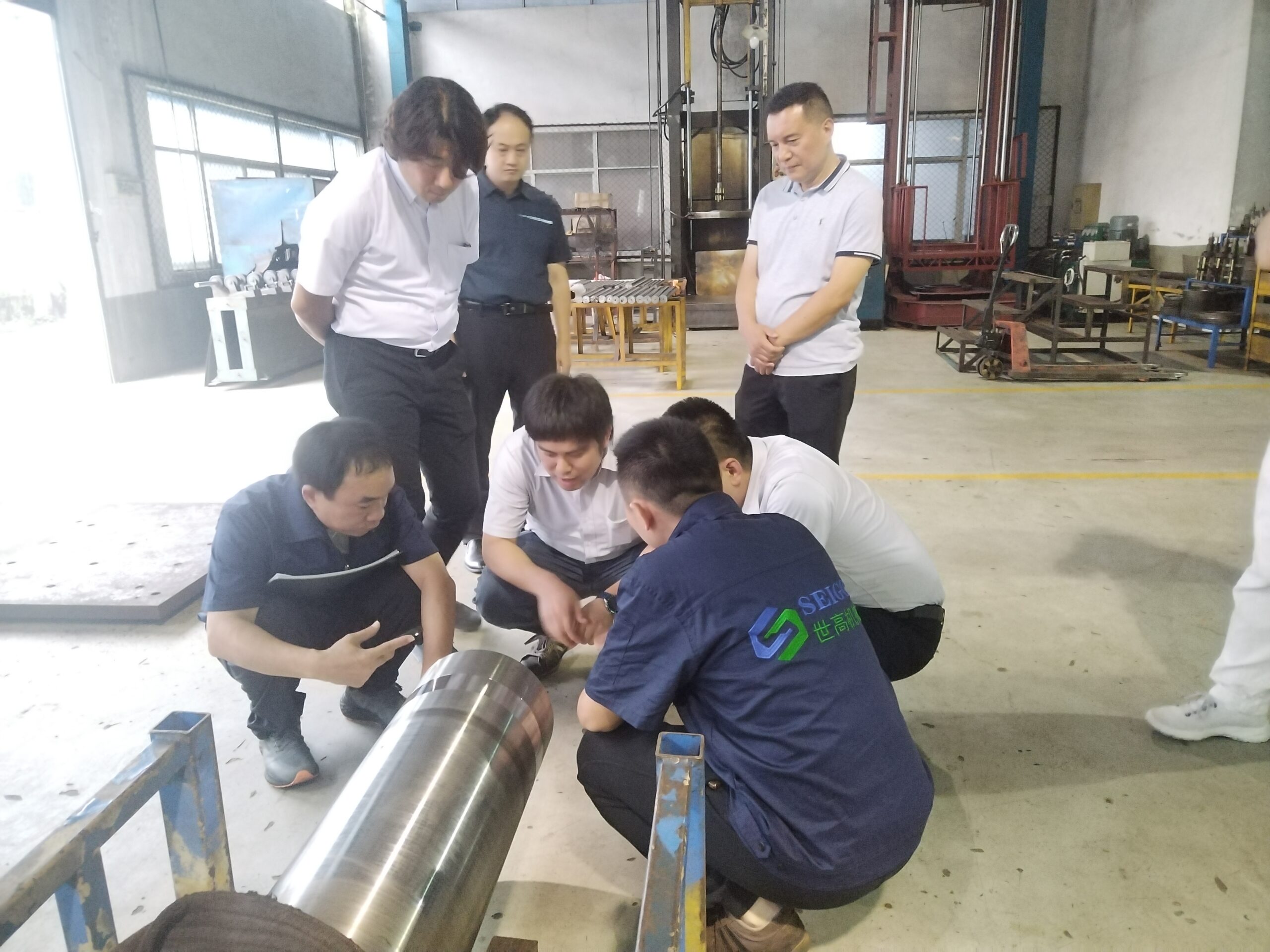
- Supplier-audit visits hosted from Komatsu’s China engineering team
Warranty terms:
- 12 months from shipment date
- Documented claim resolution process with defined response timelines
- Return freight covered on confirmed manufacturing defects
- Photographic and third-party inspection evidence accepted for large cylinders where return shipping is uneconomical
The point of publishing these details is straightforward: a manufacturer confident in its quality system invites verification rather than deflecting it. Buyers running the qualification framework in this guide should find SEIGO’s documentation straightforward to verify independently.
Qualifying a hydraulic cylinder supplier and need documentation?
SEIGO provides complete quality documentation — ISO certification, business license, material certificates, pressure test protocols, and audit history — on first inquiry.
Request Quality Documentation Package → Download the SEIGO Cylinder Catalog (PDF) →
SEIGO Machinery Equipment Co. is an ISO 9001-certified manufacturer of hydraulic cylinders for excavators, wheel loaders, dump trucks, drill rigs, mining equipment, and industrial applications. Thirty years of OEM-grade manufacturing experience, monthly capacity exceeding 6,000 units, and complete quality documentation available for buyer verification.
Disclaimer: Certification costs, inspection service pricing, and audit fee ranges cited reflect published 2026 market data and vary by provider, location, and scope. Buyers should obtain specific quotes for their requirements. ISO 9001 certification requirements are summarized for general guidance — refer to the current ISO 9001:2015 standard text for authoritative requirements.
Related Reading:
- Factory Direct Hydraulic Cylinder Procurement: 10 Questions to Ask Your Chinese Manufacturer
- How to Source Heavy Equipment Hydraulic Cylinders: OEM, Aftermarket & Direct Factory Compared
- Tariff Impact on Hydraulic Cylinder Procurement 2026: How US Buyers Can Protect Their Supply Chain