The trade landscape for hydraulic cylinder import from China has shifted three times in the past twelve months. Anyone running a procurement budget on assumptions made in early 2025 is almost certainly working with stale numbers — and probably overpaying as a result.
This is the practical version of the 2026 tariff impact on hydraulic cylinder procurement. No politics, no speculation. Just what’s currently on the books, what it means for landed cost on a typical excavator boom cylinder, and what US buyers can actually do about it before the next policy shift.
The 2026 Tariff Stack on Hydraulic Cylinders: What’s Actually Owed
Before any sourcing strategy makes sense, the duty math needs to be on the table. Hydraulic cylinders fall under HTS subheading 8412.21 (Hydraulic power engines and motors, linear acting). The standard statistical breakouts most exporters ship under are 8412.21.0030 (welded fused type), 8412.21.0045 (telescoping), and 8412.21.0075 (other linear acting cylinders).
Here’s the current duty stack on a China-origin shipment under that classification, valid as of April 2026:
| Layer | Rate on HTS 8412.21 | Status |
|---|---|---|
| MFN Base Duty (Column 1 General) | 0% (Free) | Permanent |
| Section 301 List 1 | 25% | Active since 2018 |
| Section 232 (Derivative steel content) | 25% | Conditional — applies if steel sub-components exceed annex thresholds |
| Section 122 (Reciprocal global) | 10% | Effective Feb 24, 2026; sunset July 24, 2026 unless extended |
| MPF (Merchandise Processing Fee) | 0.3464% | Min ~$32, max ~$634 per entry |
| HMF (Harbor Maintenance Fee) | 0.125% | Ocean freight only |
For a typical excavator boom cylinder with no steel-derivative complications, the effective duty rate on a China-origin landed shipment in mid-2026 sits at roughly 35% — 35.4% with fees. That’s not a forecast. That’s what CBP is actually collecting today.
A worked example: a 20-foot container of mid-size loader hydraulic cylinder units invoiced FOB Qingdao at $48,000 CIF Long Beach. The duty calculation:
- Section 301: $48,000 × 25% = $12,000
- Section 122: $48,000 × 10% = $4,800
- MPF: $48,000 × 0.3464% = $166
- HMF: $48,000 × 0.125% = $60
- Total duties + fees: $17,026 (roughly 35.5% of CIF value)
Two notes that matter. First, MFN base on linear-acting hydraulic cylinders is genuinely zero — that part hasn’t changed. The full duty burden comes from the 301 layer plus Section 122. Second, Section 232 is the dark horse. If a customs broker (or worse, CBP on audit) determines that the steel content in a finished cylinder triggers the derivative product rules under the February 2025 Proclamation 10708 expansion, an additional 25% lands on top retroactively. Several precision machining importers have already discovered this the hard way during 2025 entry liquidations.
What Changed in 2025–2026: The Short Version
If you’ve been tracking trade policy casually, here’s what actually shifted with respect to hydraulic equipment imports:
April 2025 – February 2026: IEEPA “reciprocal” tariffs added a 10% layer (China-specific stack reached 20% IEEPA before the SCOTUS ruling). For roughly ten months, the all-in duty rate on hydraulic cylinder imports from China sat near 45%.
November 1, 2025: The Trump–Xi summit produced a bilateral framework. The fentanyl-related IEEPA layer dropped from 20% to 10%. USTR extended 178 product-specific Section 301 exclusions through November 10, 2026. Hydraulic cylinder generic categories did not receive blanket exclusion.
February 20, 2026: The Supreme Court’s ruling in Learning Resources, Inc. v. Trump invalidated IEEPA-based tariffs as unconstitutional. Refunds on IEEPA duties paid between April 2025 and February 2026 became available through the CBP CAPE portal that opened April 20, 2026.
February 24, 2026: Section 122 (Trade Act of 1974) immediately replaced the void IEEPA layer with a 10% global reciprocal tariff. Net effect for China-origin hydraulic cylinder imports: the all-in rate dropped from ~45% to the current ~35%. Section 301 was not affected by the SCOTUS ruling — it has separate statutory authority and remains in full force.
March 11, 2026: USTR initiated a new Section 301 investigation into excess capacity in 16 economies including China. Public comment closed April 15. Outcome expected before Section 122 sunset on July 24, 2026.
The takeaway isn’t that things are settling down. The takeaway is that the specific layers are volatile, but the underlying reality — that China-origin hydraulic equipment carries a 25–35% effective duty wedge versus most alternatives — is structural and is going to outlast any single administration.
What This Actually Costs Per Unit
The abstract percentages get more concrete when you put them next to an actual invoice. Below is a real-world price comparison structure that procurement managers can stress-test against their own quotes.
A representative case: a US dealer is sourcing a CAT-compatible boom cylinder for the 320-class excavator. Three quote scenarios, all priced to a comparable workmanship standard:
| Sourcing Channel | Unit Cost (Landed) | Lead Time | Duty Layer Burden |
|---|---|---|---|
| Caterpillar OEM (US dealer) | $4,200 – $5,800 | 2–6 weeks | Already baked into US dealer price |
| US-stocking aftermarket distributor | $2,400 – $2,900 | 1–3 days | Importer absorbed duties, marked up |
| Factory-direct from China (mid-tier) | $1,250 + freight + 35% duty | 35–45 days | Buyer holds duty exposure directly |
Run the factory-direct math: $1,250 unit + ~$120 prorated freight + ~$486 duty stack = roughly $1,856 landed. That’s still a 36% saving against the cheapest US-stocked aftermarket unit, and a 56–68% saving against OEM dealer pricing — after the full 35% duty hit.
This is why the casual “tariffs make China sourcing uneconomical” narrative misses the point. For commodity hydraulic cylinder products and standard excavator hydraulic cylinder replacements, the China cost basis is low enough that even a 35% duty wedge leaves meaningful margin on the table. Where the math breaks down is for low-volume specialty cylinders where the per-unit duty in absolute dollars becomes large relative to the freight, broker, and inventory carrying costs.
Three Strategies to Protect the Supply Chain
Tariff exposure is a problem that compounds. Every procurement cycle that ignores it pays the bill twice — once at the port and once in lost margin downstream. There are three strategies that actually work in the current environment, in descending order of long-term impact.
Strategy 1: Compress the Importer Markup Stack with Factory-Direct Procurement
The single most expensive line item in most US hydraulic cylinder supply chains isn’t the tariff. It’s the cumulative markup chain between the Chinese manufacturer and the end buyer.
A typical aftermarket cylinder priced at $2,600 on a US distributor’s shelf will have moved through:
- Chinese factory FOB price: $1,100
- Importer/wholesaler landed cost (with 35% duty): ~$1,710
- Distributor gross margin (35–45%): ~$2,400
- Dealer markup (10–15%): $2,640
The duty layer is real, but the larger pool of recoverable cost is the importer-distributor-dealer cascade that follows it. Factory direct hydraulic cylinder China procurement doesn’t eliminate tariffs — it eliminates the layered margins that historically padded out the wholesale pipeline before tariffs ever became part of the conversation.
This isn’t a new idea. It’s how Walmart sources, how Home Depot’s private-label lines work, and how virtually every serious B2B procurement operation has run for thirty years. What changed in 2025–2026 is that the tariff math made it more visible: if a buyer is going to absorb a 35% duty regardless, they may as well capture the rest of the margin chain that previously sat with intermediaries.
What factory-direct procurement realistically requires:
- Container-quantity ordering (typically 20–40 units per SKU, depending on cylinder size). Below that, freight and broker fees eat the savings.
- A customs broker relationship that can correctly classify HTS 8412.21 entries and properly document Section 232 derivative-content carve-outs where they apply.
- Lead time tolerance of 35–45 days from order placement to US arrival. Forward-stocking solves this once the relationship is established.
- A pre-qualified manufacturer with documented ISO 9001 quality systems, real OEM relationships, and a track record of dimensional accuracy for aftermarket replacement work.
That last point is where most factory-direct programs go wrong. Saving 30% on the unit price means nothing if 8% of the units fail inspection or arrive with non-spec rod chrome thickness. A reliable hydraulic cylinder supplier in China is one with a paper trail of OEM-grade relationships, not just a polished website.
Strategy 2: Forward-Stock Inventory Ahead of the Next Policy Move
The Section 122 layer expires by statute on July 24, 2026. Whether it gets extended, replaced, or modified is genuinely unknown. What’s not unknown is that USTR’s March 11, 2026 Section 301 investigation specifically targets capacity in strategic sectors — and machinery components are squarely in scope.
Most distributors and dealers with steady demand for excavator and loader cylinder products are quietly buffer-stocking 60–90 days of forward inventory while the duty stack sits at 35% rather than 45–55%. This is straightforward defensive play. If the next policy move adds another 10–25% layer (which several outcomes of the current investigation could produce), pre-tariff inventory becomes pre-tariff margin protection.
The cost of carrying inventory at warehouse-level financing rates of 6–8% is far less than the cost of a 15% surprise tariff increase on a six-month sales window. Run the numbers on your own SKU velocity. For most active replacement cylinder lines, the math favors forward-stocking through Q3 2026.
Strategy 3: Diversify, But Honestly
“Reshoring” and “China + 1” are the language of trade conferences. The reality for hydraulic cylinder OEM supplier diversification is more complicated.
The serious alternatives to China for hydraulic cylinder import:
- Vietnam: Rising capacity, but most Vietnamese cylinder manufacturers source rod stock and seals from China. Section 232 derivative-content rules can still apply. Quality variance is wider than the China average.
- India: Strong on standard NFPA tie-rod cylinders. Less competitive on heavy-equipment custom cylinder work. Lead times often exceed China by 15–25 days.
- Mexico: USMCA-qualified production avoids Section 301 entirely, but capacity is concentrated in OEM-tier supply rather than aftermarket. Pricing typically 15–25% above China factory-direct even after tariff adjustment.
- Domestic US: Real option for low-volume custom and mill-duty work. Pricing typically 60–120% above China factory-direct landed cost. Lead times competitive on standard pre-engineered units.
The honest framing is that diversification is a multi-year program, not a procurement memo. The buyers protecting their supply chains best are running parallel relationships — primary China sourcing for cost-sensitive volume SKUs, US or Mexico for time-critical or specialty work, and active development of a backup Asian alternative in case Section 301 escalates further. None of that is fast. All of it is necessary.
A Note on Refunds: Money That’s Actually Recoverable
If a US buyer imported hydraulic cylinder shipments from China between April 5, 2025 and February 24, 2026, IEEPA duties were paid as part of the duty stack during that window. Those specific duties are now refundable.
The refund mechanism:
- File through the CBP CAPE portal (opened April 20, 2026)
- ACE Secure Data Portal registration required
- ACH enrollment for electronic refund
- Statutory interest accrues at 7% for individual importers, 6% for corporations, compounded daily under 19 CFR 24.36
- Funds typically issue 60–90 days after declaration acceptance
Important: only the IEEPA portion is refundable. Section 301 duties paid during the same period stay paid. For a typical $100,000 entry that paid 45% total during the IEEPA window, the recoverable portion is approximately $20,000 plus interest — not the full $45,000.
If your customs broker hasn’t already started this process for entries in scope, that’s a conversation worth having this week.
Why SEIGO’s Factory-Direct Model Holds Up Under Tariff Pressure
SEIGO Machinery operates as a 30-year family-owned manufacturer, not as an export trading company. The distinction matters more under the current tariff structure than it did before.
What it changes practically:
- No middleman markup before the tariff layer. Every dollar a buyer doesn’t spend on importer/trading-house margin compounds against the 25% Section 301 rate. A $200 reduction in pre-duty FOB cost saves $250 net of duty, freight, and broker prorations.
- Direct CAD/engineering review within 24 hours. Procurement teams aren’t bouncing specifications through trading-company sales staff. Engineering questions get engineering answers, same business day.
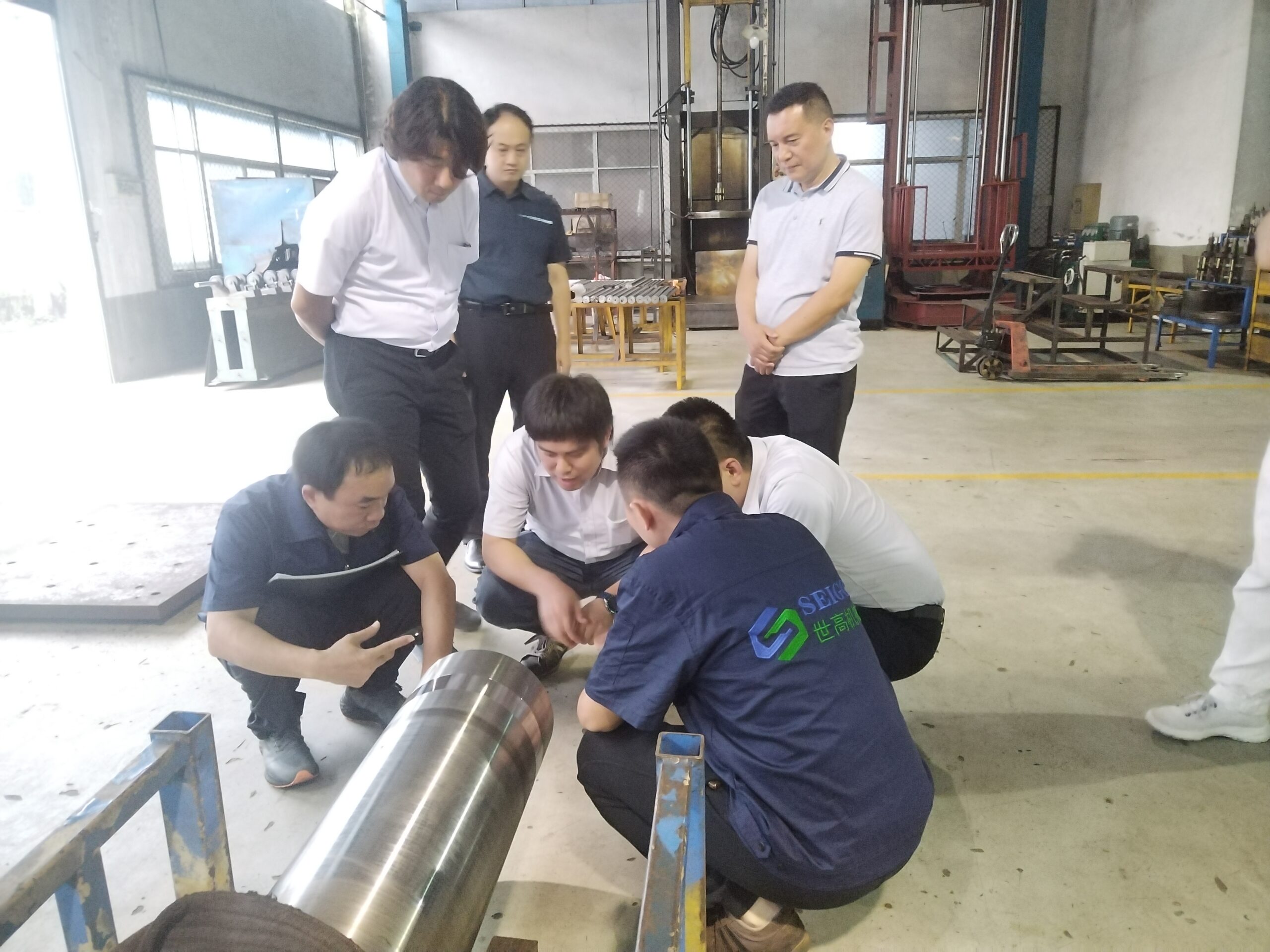
- ISO 9001 quality system with documented OEM history. SEIGO’s manufacturing record includes verified OEM supply work for Yuchai Heavy Industry and supplier-audit visits from Komatsu’s China team. That paper trail matters when a US customs broker or a quality-conscious buyer needs to verify supplier credentials.
- Flexible Incoterms (FOB / CIF / DDP). For buyers who’d rather not manage the duty stack directly, DDP terms shift the customs burden back to the manufacturer side — useful for distributors who lack in-house import expertise.
- Monthly capacity of 6,000+ units with rapid production track for urgent orders. Forward-stocking strategies require a supplier that can replenish predictably, not one that quotes 90 days when the catalog says 45.
For dealers and distributors running custom hydraulic cylinder programs alongside aftermarket replacement work, SEIGO’s CAD-to-prototype process compresses the entire sample-to-production cycle to 4–6 weeks for new designs. That’s the workflow, not a marketing claim.
What to Do This Week
Three concrete actions for procurement teams reading this:
- Pull your last 12 months of HTS 8412.21 entries. Verify duty stack accuracy and confirm whether any Section 232 derivative-content liability is sitting unaddressed. A misclassified entry can be quietly accumulating retroactive exposure.
- Run the IEEPA refund check. If any of those entries dated between April 5, 2025 and February 24, 2026, your customs broker should be opening CAPE filings. The refund window has a statute of limitations attached.
- Get a factory-direct quote for your top three replacement cylinder SKUs. Compare against your current US-distributor landed cost. Even with the 35% duty layer included, the gap is typically wide enough to fund a forward-stocking strategy entirely from year-one savings.
The tariff environment isn’t going to simplify. The buyers who do best in the next 18 months will be the ones who treat duty exposure as a procurement design problem, not a line item on a vendor invoice.
Need a factory-direct quote that includes the full landed cost?
SEIGO’s engineering team will spec, quote, and document delivery terms — including DDP options that handle the customs side for you — within 24 hours.
Request a Custom Quote → Download Our Cylinder Catalog (PDF) →
SEIGO Machinery Equipment Co. is an ISO 9001-certified manufacturer of hydraulic cylinders for excavators, loaders, dump trucks, drill rigs, and industrial applications. With 30 years of OEM-grade manufacturing experience, monthly capacity exceeding 6,000 units, and a dedicated rapid-production track, we serve global distributors and equipment fleets with factory-direct pricing.
Disclaimer: This article reflects publicly available US Customs and Border Protection guidance, USTR Section 301 documentation, and tariff schedule data current as of April 2026. Trade policy is subject to change. Importers should consult a licensed customs broker for entry-specific duty determination. SEIGO Machinery does not provide legal or trade compliance advice.
Related Reading:
- The Complete Guide to Hydraulic Cylinder Sizing: How to Calculate Force, Speed & Stroke for Excavators
- Maximizing Excavator Uptime: The Ultimate Guide to Sourcing Heavy Equipment Parts in 2026
- How to Source Mining-Grade Hydraulic Cylinders: A Technical Procurement Guide
Sources & References:
- USTR Section 301 List 1 (HTSUS 8412.21.00) — ustr.gov
- US Supreme Court, Learning Resources, Inc. v. Trump (Feb 20, 2026)
- US-China Bilateral Trade Agreement, Trump-Xi Summit (Nov 1, 2025)
- CBP CAPE Refund Portal documentation (April 2026)
- Proclamation 10708 (Feb 2025) — Section 232 derivative product expansion
- USTR Section 301 New Investigation Notice (Mar 11, 2026)