There’s a moment in every cross-border procurement conversation where the supplier sends back a glossy PDF, a price that beats the local distributor by 35%, and a promise to ship in four weeks. This is the moment that separates buyers who go home with a profitable supply chain from buyers who go home with a costly lesson. The difference between those two outcomes almost always traces back to what questions got asked before the first purchase order was issued — and which ones got skipped because the quote looked good.
Factory direct hydraulic cylinder procurement from China is one of the highest-leverage sourcing decisions available to global distributors, equipment dealers, and fleet operators. Done well, it captures 30–55% of the cost that would otherwise sit with import wholesalers and distribution layers. Done poorly, it ties up working capital in undersized barrels, brittle rod chrome, leaking gland packs, and a defect rate that makes the savings disappear inside one inspection cycle.
This is the qualification framework that experienced procurement teams use to separate real OEM-grade Chinese manufacturers from trading companies with polished websites. Ten questions, in the order they should actually be asked, with what a good answer sounds like and where the red flags hide.
Why the Right Questions Matter More Than the Right Price
China is the largest single-country manufacturer of hydraulic cylinders globally, with annual capacity exceeding the rest of Asia combined. Within that volume sit two very different categories of supplier: legitimate manufacturers with documented ISO 9001 quality systems and real OEM supply credentials, and trading companies that present themselves as factories while sourcing from whatever production line offers the best margin that week. Industry data suggests approximately 30% of first-time China importers experience supplier-related issues within their first year, and factory misrepresentation is consistently among the top causes.
The qualification process below isn’t theoretical. It’s the working checklist of buyers who run successful long-term factory direct hydraulic cylinder China programs. Run through it before sending money. The questions take an afternoon. The cost of skipping them ranges from a single bad container ($15,000–$40,000) to a multi-year quality reputation problem when bad cylinders reach end customers.
Question 1: Are You the Actual Manufacturer, and Can You Prove It?
The first question separates roughly 40% of the suppliers on B2B platforms from the remaining 60%. Trading companies will say “we have our own factory” — manufacturers will produce evidence.
What to ask for:
- Business license confirming “manufacturing” as the registered business scope (not “trading” or “wholesale”)
- Production facility address and a video walkthrough of the actual machining shop, honing line, painting line, and assembly area
- Export license verification (legal authorization to ship internationally)
What a good answer looks like: same-day delivery of business license, video walkthrough or live video call from the production floor, and a documented production capacity figure expressed in units per month.
What a red flag looks like: business license shows trading scope; reluctance to share facility video; vague “we work with several factories” answers; production address that doesn’t match the business license registration.
Verification step: cross-check the business license against Tianyancha or Qichacha (China’s two main corporate verification databases), confirming registration date, registered capital, business scope, and litigation history.
Question 2: Is Your ISO 9001 Certificate Currently Valid?
ISO 9001 certification is one of the genuine differentiators in the Chinese hydraulic cylinder manufacturing market. Roughly half of small-to-mid manufacturers display ISO 9001 on their website; a meaningful portion of those certificates have expired, been suspended, or were issued by non-accredited bodies that aren’t recognized internationally.
What to ask for:
- Current ISO 9001 certificate (must be valid, not expired)
- Name of the certification body that issued it
- Scope of certification (must specifically cover hydraulic cylinder manufacturing, not just “metal products”)
Verification step: search the IAF (International Accreditation Forum) CertSearch database at iaf.nu using the certificate number or company name. A genuine certificate will appear with confirmed validity status. Self-issued PDFs that don’t appear in the IAF database aren’t certifications — they’re marketing material.
A premium hydraulic cylinder manufacturer in China will typically also hold supplementary certifications worth confirming: CE marking for European market shipments, RoHS compliance documentation, and increasingly, IATF 16949 for automotive supply work. None of these are mandatory for hydraulic cylinder export, but their presence signals a serious quality system.
Question 3: What Are Your Rod Chrome Thickness and Tube Honing Specifications?
This is the question that immediately exposes whether the engineering conversation is happening with a real factory or with a sales department reading from a script. There are correct numerical answers, and the supplier should provide them without hesitation.
The reference specifications for OEM-grade hydraulic cylinder manufacturing:
- Rod chrome thickness: ≥25 µm (premium specification reaches 30–35 µm for mining and severe-duty applications)
- Rod surface roughness: Ra ≤0.2 µm
- Cylinder tube material: 27SiMn alloy steel or honed 45# carbon steel
- Tube inside diameter (ID) tolerance: H8 standard or tighter
- Tube surface roughness (ID): Ra ≤0.4 µm
A factory that produces OEM-grade work answers these in seconds and can supply third-party metallurgical test reports on request. A supplier who responds with “our chrome is thick” or “we use high-quality steel” is either understaffed on the engineering side or, more commonly, doesn’t actually own the production line. This question alone filters out a significant portion of suppliers.
Question 4: What Is Your Standard Pressure Test Protocol?
Every hydraulic cylinder leaving a serious factory should have been pressure-tested before it shipped. The test is straightforward: pressurize the cylinder to 1.5× rated working pressure and hold for a defined period, monitoring for pressure decay. The cylinder either passes or it doesn’t.
What to ask:
- Is every cylinder pressure-tested before shipment, or only sample testing?
- What test pressure is used relative to rated working pressure?
- How long is the test held?
- Can you provide individual pressure test certificates with each shipment?
The benchmark for OEM-grade production:
- 100% of units tested (not sample testing)
- 1.5× working pressure minimum (e.g., 52.5 MPa for a 35 MPa working pressure cylinder)
- 5-10 minute hold with pressure decay monitoring
- Individual test certificate issued and shipped with each cylinder
What a red flag looks like: “we sample-test our production batches” — sample testing is a quality cost-cutting measure that means the specific cylinder you receive may or may not have been tested. For premium aftermarket and OEM-grade work, 100% testing is the industry standard.
Question 5: Which Seal Brand Do You Use, and What Are Your Options?
“Premium seals” is meaningless. NOK, Parker, Trelleborg, Hallite, SKF — these are real seal brands with verifiable supply chains. A serious hydraulic cylinder manufacturer specifies the seal vendor by name and series, not by adjective.
What to ask:
- What is your standard seal package (vendor and material)?
- What upgrade options are available (e.g., NOK Japan, Parker Prädifa Germany)?
- Can you supply FKM/Viton seals for high-temperature or fire-resistant fluid applications?
- What is the price differential between standard and upgrade seal packages?
The reference standard for OEM-grade Chinese hydraulic cylinder manufacturing is NOK (Japan) seal packages as the baseline, with Parker Prädifa as an upgrade option for severe-duty applications. Anyone quoting unbranded “imported equivalent” seals at standard pricing is using domestic Chinese seal material — not necessarily bad, but not what the spec calls for either.
Question 6: Who Are Your Existing OEM or Major Brand Customers?
A factory that genuinely supplies OEM work for major equipment brands has a documented paper trail and can reference it. A factory that wants to sound impressive but doesn’t have the credentials will pivot to vague claims about “many international customers” without naming any.
What to ask:
- Have you supplied OEM-grade work for any of: Komatsu, Caterpillar (or CAT-compatible aftermarket programs), Volvo, Hitachi, Doosan, John Deere, XCMG, SANY, LiuGong, or other major equipment OEMs?
- Can you provide reference customer names (with permission) in the relevant region or industry?
- Have you been audited by any major OEM customer? Can you share the audit summary?
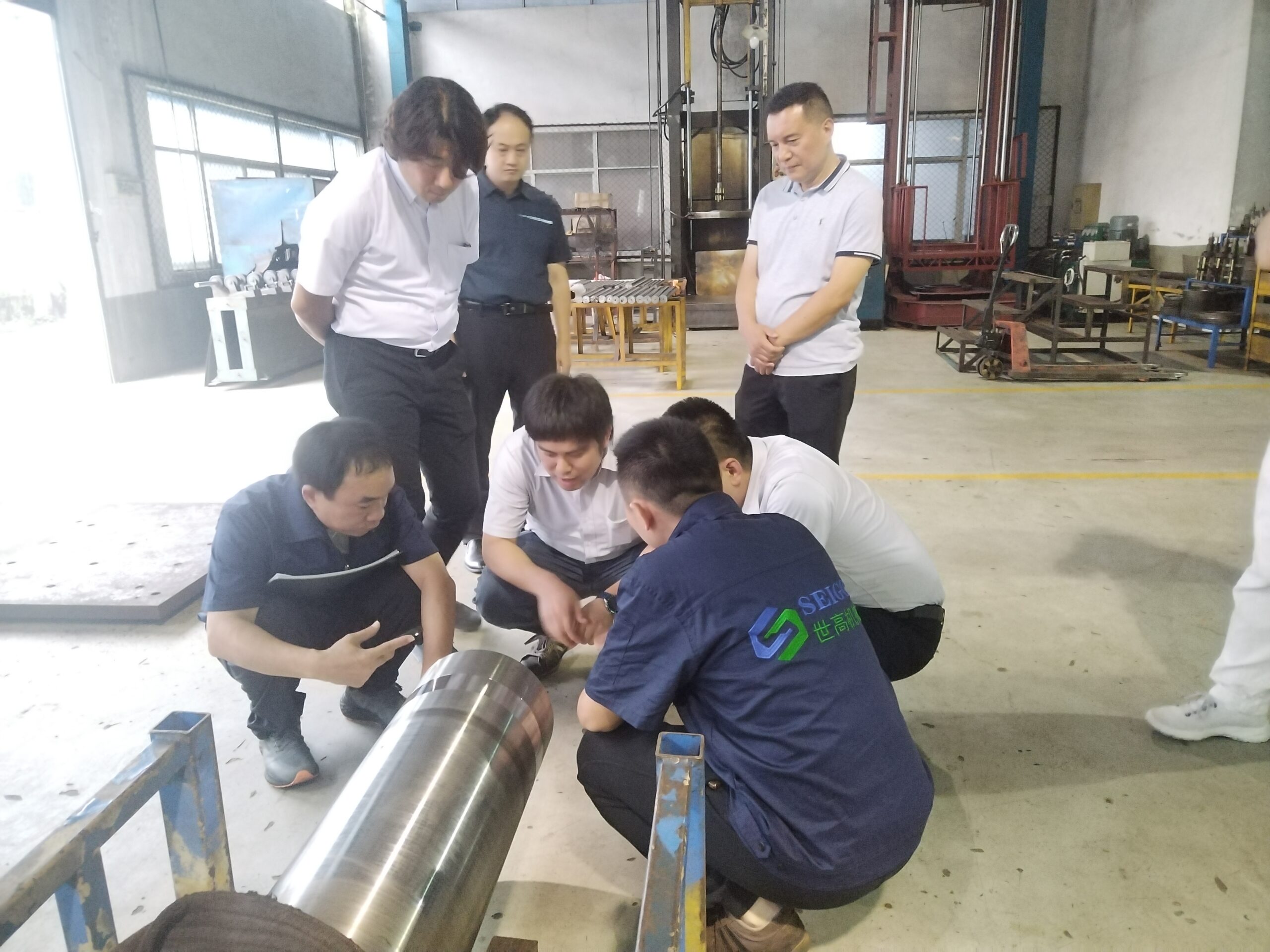
The audit history piece is meaningful. Manufacturers who have hosted supplier audits from a major OEM (for example, Komatsu’s China supplier team) carry a credibility marker that no amount of marketing can replace. The audit history isn’t confidential — manufacturers proud of those relationships will share the audit summary readily.
A red flag worth flagging clearly: a supplier who claims OEM credentials but can’t produce a single named reference, a single audit report, or even a customer logo wall photograph. Real OEM relationships generate paper trails.
Question 7: What Are Your MOQ, Lead Time, and Production Capacity?
The numbers should be specific, internally consistent, and align with the production scale visible in the facility walkthrough.
Reference numbers for established Chinese hydraulic cylinder manufacturers:
- MOQ: Typically 20–40 units per SKU for standard sizes; custom designs often start at 50 units; sample orders of 1–5 units negotiable for new buyer relationships
- Lead time: 35–45 days for standard production from order confirmation to ready-for-shipment; rapid-production track of 15–25 days available at premium with capacity availability
- Monthly capacity: Established mid-size factories produce 3,000–8,000 cylinders monthly; large OEM-tier facilities exceed 10,000
The internal consistency check: a factory claiming 10,000 units monthly capacity should have a facility large enough to support that throughput, not a 500 m² workshop. A factory quoting 20-day lead times on every order regardless of complexity is either underutilized (which raises its own questions) or quoting optimistically. Both signals deserve follow-up.
A common procurement mistake is accepting MOQs at face value without negotiation. For new buyer relationships, sample orders of 1–5 units are typically accommodated at slightly higher per-unit cost. Established suppliers prefer building a relationship over enforcing rigid MOQ on first order.
Question 8: What Are Your Payment Terms, and What Trade Assurance Do You Offer?
Payment structure is one of the cleanest indicators of supplier seriousness and financial discipline. Reasonable terms protect both parties. Aggressive terms — in either direction — signal something off about the operation.
The standard payment structure for hydraulic cylinder import China shipments:
- 30% deposit by T/T (telegraphic transfer) at order confirmation
- 70% balance against bill of lading copy (paid before original shipping documents are released)
- Alibaba Trade Assurance available for orders placed through that platform (escrows payment until quality and delivery are confirmed)
- Letter of Credit (LC) for orders above $100,000 USD with established suppliers
Red flags on payment:
- Supplier demands 100% upfront payment (no legitimate manufacturer requires this from established buyers)
- Supplier refuses to ship against bill of lading copy and insists on full payment before any shipping document release
- Supplier rejects Trade Assurance for new-customer orders (signals reluctance to be held accountable to platform-level dispute resolution)
- Supplier demands payment to a personal bank account rather than the registered corporate account
Negotiation patterns worth knowing: For the first 2–3 orders with a new supplier, FOB or CIF terms are appropriate (seller handles port-side logistics). After 3–10 successful orders, switching to FOB with buyer-selected freight forwarder typically saves 5–15% on freight costs. Established relationships at 10+ orders may move to EXW for further freight optimization, though the additional logistics complexity isn’t always worth the savings.
Question 9: What Incoterms Do You Offer, and How Do You Handle Tariffs?
Incoterms determine where supplier responsibility ends and buyer responsibility begins. For hydraulic cylinder import from China to the US, EU, Australia, or Latin America, this question matters more in 2026 than it did before the current tariff environment.
The four Incoterms most relevant to hydraulic cylinder procurement:
- EXW (Ex Works): Buyer takes responsibility from the factory gate. Cheapest unit price, maximum buyer logistics complexity. Suitable for established buyers with their own freight relationships.
- FOB (Free On Board): Seller handles port-side logistics through vessel loading. Buyer assumes risk and cost from there. Most common for hydraulic cylinder shipments globally.
- CIF (Cost, Insurance, Freight): Seller pays freight and insurance to destination port. Risk transfers to buyer when goods cross ship’s rail at origin port. Simpler for new buyers.
- DDP (Delivered Duty Paid): Seller handles everything including destination customs clearance and tariffs. Most expensive in nominal terms but simplest for buyers without import infrastructure. Particularly useful in the current US tariff environment where Section 301 duties on HTS 8412.21 (linear acting hydraulic cylinders) sit at 25%.
Premium suppliers offer all four options and can quote against any of them on request. Suppliers who only work in FOB or CIF often lack the destination-country licensing or customs broker relationships to handle DDP, which is a limitation worth knowing before committing to a relationship.
For US buyers specifically: a manufacturer that can quote DDP terms inclusive of current US tariff exposure removes a significant operational burden from the procurement side, and it shifts the customs broker management to the supplier’s account.
Question 10: What Is Your Warranty, and What’s the Process if Something Fails?
The warranty conversation reveals everything about how a supplier thinks about long-term customer relationships. Suppliers who view each order as a transaction give vague warranty answers. Suppliers who view orders as the start of a relationship treat warranty as a real commitment with documented process.
What to ask:
- What is your standard warranty period (months or operating hours)?
- What does the warranty cover (parts, labor, freight return)?
- What is the documented process for warranty claims?
- What is the expected resolution time on a warranty claim?
- How do you handle a defect found at destination (replacement, refund, credit)?
The premium aftermarket industry standard for hydraulic cylinder warranty is 12 months from shipment date or 2,000 operating hours, whichever occurs first. Some severe-duty applications carry 18-month warranty. Suppliers offering only 6-month warranty are signaling lower confidence in their own production, not generosity.
The process matters as much as the duration. A warranty that requires the buyer to ship a failed cylinder back to China at their own cost, wait 60 days for inspection, and then potentially get a credit on the next order is technically a warranty but practically worthless on a single cylinder failure. Premium suppliers offer documented procedures with reasonable resolution timelines and clear responsibility allocation for return freight on confirmed defects.
What a Strong Set of Answers Looks Like
A factory that passes all ten questions cleanly demonstrates the following profile:
- Verified manufacturer (not trading company) with documented business license, production facility, and export license
- Valid ISO 9001 certificate from an IAF-accredited certification body, with scope covering hydraulic cylinder manufacturing
- Detailed engineering specifications on rod chrome (≥25 µm), surface finish (Ra ≤0.2 µm), tube material (27SiMn or 45#), and pressure testing protocol (100% at 1.5× working pressure)
- NOK (Japan) seal packages as standard, with documented upgrade options for severe-duty applications
- Real OEM customer references with audit history that can be confirmed
- Production capacity, MOQ, and lead times that are internally consistent and verifiable against facility scale
- Standard 30/70 payment terms with Trade Assurance and LC options
- All major Incoterms available including DDP for tariff-burdened destinations
- 12-month warranty minimum with documented claim resolution process
That profile describes a relatively small percentage of the supplier population on B2B platforms — perhaps 10–15% of self-described “hydraulic cylinder manufacturers.” Identifying them is the work that produces a profitable long-term sourcing program, and skipping the work is what produces the bad outcomes that give factory direct procurement its uneven reputation.
How SEIGO Answers These Ten Questions
The framework above is the standard. Here’s how SEIGO Machinery measures against it:
1. Verified manufacturer. Family-owned manufacturer operating since the mid-1990s with registered business scope covering hydraulic cylinder design, manufacturing, and export. Production facility located in Linyi, Shandong Province with documented manufacturing capacity. Tianyancha-verifiable corporate registration.
2. ISO 9001 certified. Current and valid ISO 9001:2015 certification covering hydraulic cylinder manufacturing. IAF database-verifiable.
3. OEM-grade engineering specifications. Rod chrome thickness ≥25 µm (mining-class production extends to ≥30 µm), surface roughness Ra ≤0.2 µm, cylinder tube 27SiMn alloy steel or 45# carbon steel honed to H8 tolerance.
4. 100% pressure testing. Every cylinder pressure-tested at 1.5× working pressure before shipment, with individual test certificate accompanying each unit.
5. NOK seal packages standard. NOK (Japan) seals as standard specification, with Parker Prädifa available on request for severe-duty mining applications, and FKM/Viton for high-temperature work.
6. Documented OEM history. Direct OEM supply work for Yuchai Heavy Industry, with supplier-audit visits hosted from Komatsu’s China team. CAT-compatible, Volvo-compatible, Hitachi-compatible, and Komatsu-compatible aftermarket programs across the full medium and large excavator range.
7. Capacity and lead time. Monthly production capacity exceeding 6,000 units. Standard lead time 35–45 days factory direct. Rapid-production track available for urgent fleet downtime situations. Sample orders accommodated for new buyer relationships.
8. Standard payment terms. 30% T/T deposit, 70% balance against bill of lading copy. Alibaba Trade Assurance available. Letter of Credit accepted for larger orders.
9. Full Incoterms range. FOB, CIF, DDP all available, including DDP terms that handle current US Section 301 tariff exposure inclusive in landed cost quote.
10. 12-month warranty standard. Documented warranty claim resolution process with reasonable response timelines. Return freight covered on confirmed manufacturing defects.
For procurement teams running an evaluation against the framework above, SEIGO welcomes the full qualification exercise — including independent third-party factory audits before any commercial commitment. That openness is the point of the framework: serious manufacturers want serious buyers asking serious questions.
Ready to qualify a hydraulic cylinder manufacturer with the questions that matter?
SEIGO’s engineering and commercial teams provide complete documentation against all ten questions on first inquiry. No deflection, no marketing slides — just the answers procurement teams actually need.
Request Factory Documentation Package → Download the SEIGO Cylinder Catalog (PDF) →
SEIGO Machinery Equipment Co. is an ISO 9001-certified manufacturer of hydraulic cylinders for excavators, wheel loaders, dump trucks, drill rigs, and industrial applications. Thirty years of OEM-grade manufacturing experience, monthly capacity exceeding 6,000 units, and full procurement documentation including business license, export license, ISO certification, OEM audit history, and third-party metallurgical test reports available on request.
Related Reading:
- Tariff Impact on Hydraulic Cylinder Procurement 2026: How US Buyers Can Protect Their Supply Chain
- CAT Excavator Hydraulic Cylinder Replacement Guide: OEM vs Aftermarket Comparison
- Komatsu PC200/PC300 Hydraulic Cylinder Specs & Replacement Guide