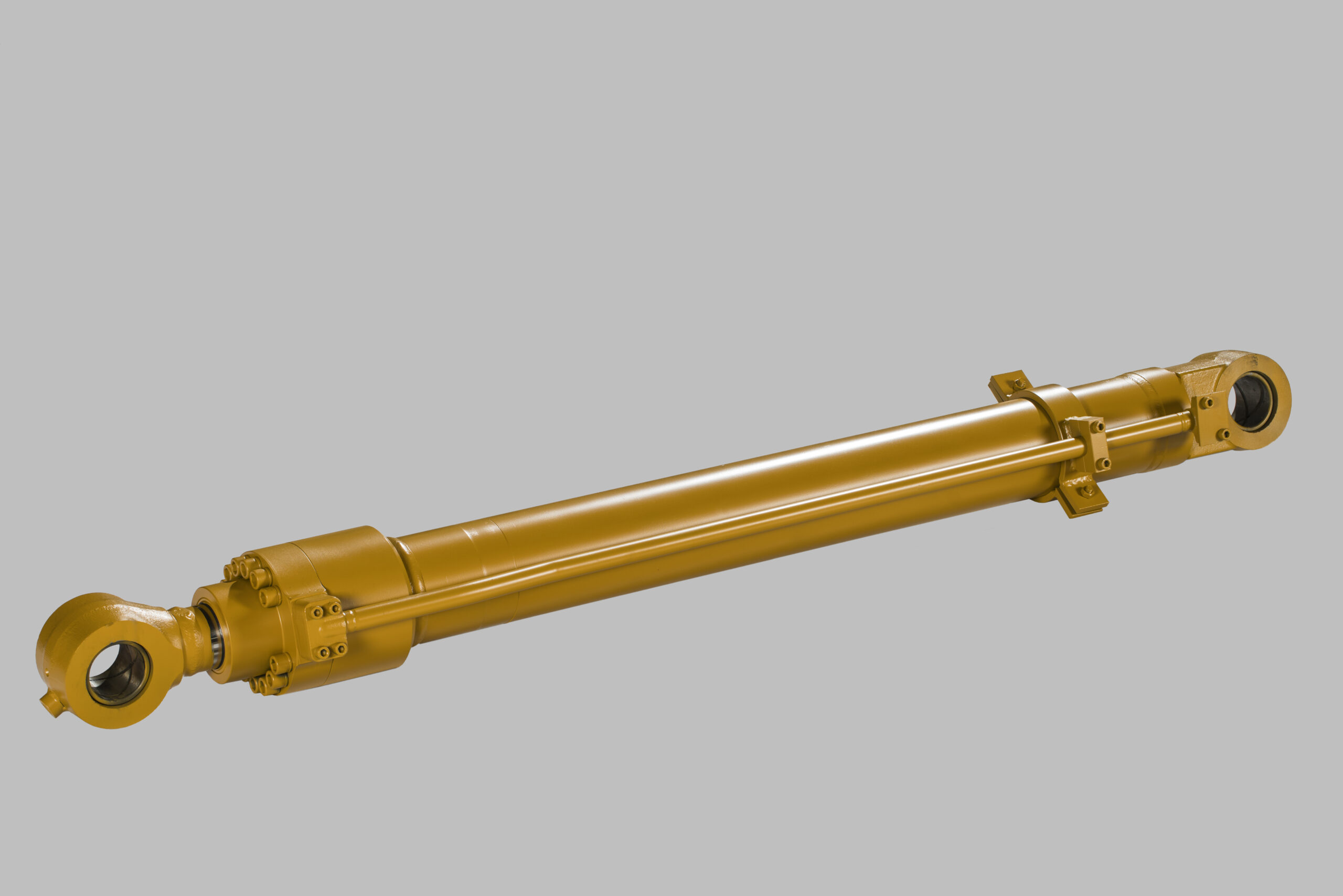
Look at the cylinder on a hydraulic floor jack lifting a car. Now look at the boom cylinder on an excavator swinging a full bucket. Both are converting pressurized fluid into linear motion. Both look superficially similar — a tube, a rod, a piston, some seals. But they’re built on opposite engineering principles, and the difference between them shapes every design decision that follows: how the cylinder is sized, how the hydraulic circuit is plumbed, what it costs, and ultimately what kind of work it can do.
The floor jack uses a single acting hydraulic cylinder. The excavator boom uses a double acting hydraulic cylinder. The reason isn’t tradition or accident — it’s that two completely different jobs demand two completely different solutions. This guide breaks down the single acting vs double acting hydraulic cylinder comparison the way engineers, OEM designers, and equipment buyers actually need to see it: working principles first, then real-world application boundaries, then the selection logic that gets the right cylinder onto the right machine.
How a Single Acting Hydraulic Cylinder Works
A single acting hydraulic cylinder is the simpler of the two designs in every measurable way. Fluid pressure is applied to one side of the piston only. The piston extends. When the pressure is released, something else — gravity, a return spring, or the weight of the load itself — pushes the piston back to its starting position. There’s no hydraulic fluid on the return side. There’s no second port. There’s no controlled retraction.
The mechanical configuration is straightforward: a single hydraulic port located near the cap end (or the rod end, depending on whether it’s a push or pull design), an internal piston with a sealed working face, and a piston rod that exits through the gland with its own seal package. The return mechanism varies by application — an internal spring inside the barrel for compact industrial cylinders, gravity for vertical lift applications, or an external load that pushes the rod back when fluid is released.
Two configurations dominate single acting cylinder design:
Push-type single acting cylinder. Fluid enters the cap-end port and forces the piston out. At rest, the piston is fully retracted. This is the standard configuration for lifting applications — floor jacks, hydraulic presses, scissor lifts, and most clamping operations. The load itself or a return spring brings the piston back when pressure releases.
Pull-type single acting cylinder. Fluid enters and pulls the piston into the cylinder body. At rest, the rod is fully extended. This less common configuration shows up in tensioning applications, certain industrial holding fixtures, and some specialized aerospace and material handling systems.
The design simplicity translates directly into cost and reliability advantages. A single acting cylinder has fewer seals, fewer machined surfaces, no second port assembly, no need for matched flow on the return side, and a less complex hydraulic circuit feeding it. Maintenance is simpler because there’s literally less to fail. For applications where the cylinder only needs to push in one direction and natural forces handle the return, the single acting design is almost always the right engineering answer.
How a Double Acting Hydraulic Cylinder Works
The double acting hydraulic cylinder operates on a fundamentally different principle. Hydraulic fluid is applied to both sides of the piston, but never at the same time. Two ports — one at the cap end, one at the rod end — alternate between supply and return as the directional control valve switches position. When fluid enters the cap-end port, it pushes the piston out and forces fluid out of the rod-end port back to tank. When the valve reverses, fluid enters the rod-end port, retracts the piston, and pushes fluid out of the cap-end port.
This bidirectional pressurization gives the double acting hydraulic cylinder three capabilities that the single acting design cannot deliver:
Powered retraction. The return stroke is driven by hydraulic pressure, not by gravity or a spring. This means the cylinder can pull a load back as effectively as it pushed it out. On an excavator, this is what lets the operator dig the bucket into hard ground and pull it through — work that requires real force in both directions.
Controlled speed in both directions. Because both strokes are pressurized, the operator (or the control system) can meter flow to either port and adjust extension and retraction speed independently. Single acting cylinders retract at whatever speed gravity or the spring dictates, which is rarely the right speed for precision work.
Position holding under bidirectional load. A double acting cylinder with both ports closed traps fluid on both sides of the piston, hydraulically locking the rod in place. This is what holds a boom in mid-air when the operator releases the joystick. Single acting cylinders can’t do this — without pressure, they fall back to their rest position.
The trade-off is complexity. Double acting cylinders require two seals (rod seal at the gland, piston seal in the middle), two ports, more sophisticated hydraulic circuit design (directional control valve, return path management, often holding/counterbalance valves), and more meticulous installation. They cost more upfront, and they have more potential failure points. But for any application where the work itself demands force in both directions — and that describes virtually all heavy mobile equipment — they’re the only architecture that can do the job.
The Critical Asymmetry: Why Retraction Force Is Always Lower
A non-obvious but important consequence of double acting cylinder geometry: extension force and retraction force are never equal, even at the same operating pressure. This single fact shapes a lot of downstream engineering decisions, and missing it is the source of plenty of sizing mistakes.
On the extension stroke, hydraulic fluid acts on the full piston face. Effective area is the full bore cross-section:
A_extend = π × D² / 4
On the retraction stroke, the rod occupies part of the piston area. Fluid only acts on the annular surface around the rod:
A_retract = π × (D² − d²) / 4
Where D is bore diameter and d is rod diameter. The effective area for retraction is smaller — typically by 30–50% — which means the force produced at the same operating pressure is correspondingly lower. For a typical 130 mm bore × 90 mm rod cylinder running at 35 MPa, extension force is around 46.5 metric tons and retraction force is around 24 metric tons. Roughly half.
This is why excavator booms are designed to lift on extension and let gravity assist retraction. It’s why hydraulic presses always do the pressing work on extension. It’s why anyone designing a double acting circuit needs to think about which direction is doing the real work, and size the cylinder for that — not for the easy direction.
There’s also a flow consequence to this geometry. Because retraction sweeps less volume per millimeter of stroke (smaller effective area), the same pump flow makes the cylinder retract faster than it extends. Operators on heavy equipment expect this and rely on it for productive cycle times — quick repositioning between digging strokes. Designers of long-stroke cylinders need to watch for regen cavitation if the rod-side return circuit can’t handle the higher reverse flow.
Single Acting Applications: Where Simplicity Wins
The single acting hydraulic cylinder isn’t a budget version of the double acting — it’s the correct solution for an entire class of applications where bidirectional control is unnecessary and the added complexity would just add failure points and cost.
Hydraulic floor jacks, bottle jacks, and porta-power tools. Lifting a load vertically. Gravity handles the return when the relief valve opens. There’s no reason to pump fluid back into the cylinder when releasing pressure does the same job for free.
Industrial hydraulic presses (vertical). Most C-frame and H-frame presses work on extension only. The ram pushes down, the load handles the return, and the press is sized for the work that matters — the pressing stroke. The exception is high-cycle presses where retraction speed limits productivity, which is why production stamping presses are increasingly double acting.
Forklift mast cylinders (lift function). The mast cylinder lifts the load on extension; the load comes down on its own under controlled flow restriction when the operator lowers the forks. A second port and seal on the cylinder would add cost without adding capability.
Agricultural implement cylinders. Many tractor-mounted implements use single acting cylinders for tilt and depth control. The implement’s weight handles return when pressure releases. Standardized 2,500–3,000 PSI single acting cylinders from suppliers like Cross, Prince, and Chief dominate this category because they’re cheap, reliable, and fit common ASAE/SAE port and mounting standards.
Pallet jacks and material handling lift tables. Same logic — lift on extension, gravity on return. The added complexity of double acting would buy nothing useful.
Single acting clamping and positioning fixtures. A spring-return single acting cylinder is the standard solution for workpiece clamping where the clamp opens whenever pressure releases. Simpler hydraulic circuit, fewer seals to maintain, and the spring guarantees a safe-open state at power loss.
The unifying pattern: gravity, springs, or the load itself can do the return work for free, and the cycle doesn’t need precise retraction control. Add any one of those constraints and the application shifts to double acting.
Double Acting Applications: Where Bidirectional Control Is Non-Negotiable
The list of double acting hydraulic cylinder applications is much longer, and it covers essentially all heavy mobile equipment plus most modern industrial systems where productivity depends on cycle time.
Excavator boom, stick, and bucket cylinders. All three are double acting because all three need real force in both directions. The boom lifts loaded buckets up (extension) and pulls them down through hard digging (retraction). The arm crowds into the cut (extension or retraction depending on geometry). The bucket curls (extension) and dumps (retraction). Without bidirectional force, an excavator doesn’t dig — it just lifts.
Wheel loader boom, tilt, and steering cylinders. Loader booms lift loaded buckets and need controlled lowering for material placement. Tilt cylinders curl and dump the bucket. Steering cylinders need to push the wheels in either direction. All double acting, all bidirectional under pressure.
Dump truck hoist cylinders (telescopic configurations). Modern dump truck hoists are often telescopic single acting (gravity does the return) but heavy-duty applications and articulated dump trucks frequently use double acting cylinders for controlled body lowering, particularly when the operator needs to dump partial loads or feather the body position.
Skid steer loader cylinders. Lift, tilt, and auxiliary attachment cylinders are virtually all double acting on modern skid steers. The work cycles are too fast and the precision requirements too tight for single acting to be practical.
Drill rig mast cylinders and crowd cylinders. A drill needs to push the bit into the ground (extension) and pull it back when changing rods or relocating (retraction). Both directions are productive work.
Industrial production presses (high-cycle). Modern automated stamping and forging presses use double acting cylinders to control both the pressing and the return stroke, dramatically reducing cycle time versus single acting designs.
Material handling robots and pick-and-place automation. Position accuracy and cycle time both require pressurized control in both directions.
Forestry processors, demolition shears, scrap shears. The work itself involves cutting or crushing in one direction and opening the attachment in the other — both under load. Double acting is the only architecture that handles it.
The pattern is consistent: any application where the return stroke is doing real work, requires precise speed control, or needs to hold load against gravity is double acting. That covers most of the heavy equipment market.
Side-by-Side Specification Comparison
| Characteristic | Single Acting | Double Acting |
|---|---|---|
| Ports | 1 | 2 |
| Fluid action | One side of piston only | Both sides of piston |
| Return mechanism | Spring, gravity, or load | Hydraulic pressure |
| Force direction | One direction only | Both directions |
| Retraction control | Uncontrolled (depends on return force) | Fully controlled |
| Position holding | No — falls to rest under no pressure | Yes — holds with both ports closed |
| Hydraulic circuit complexity | Lower (single valve, no return management) | Higher (directional valve, return path) |
| Number of seals (typical) | 2 (rod seal, piston cup) | 3+ (rod seal, piston seal both sides) |
| Cost (relative) | Lower (often 30–50% less for similar bore/stroke) | Higher |
| Maintenance complexity | Lower | Higher |
| Typical bore range | 1″ – 12″ common; larger sizes exist | 1″ – 30″ common; up to 60″ for industrial |
| Typical applications | Jacks, presses (vertical), agricultural | Excavators, loaders, industrial automation |
The honest engineering take: neither type is “better.” They’re optimized for different problems. Choosing between them by cost alone leads to undersized control on systems that need bidirectional force, or over-engineered circuits on systems that just need to lift something and let gravity do the rest.
How to Choose: The Selection Decision Framework
The selection logic comes down to four questions answered in order:
1. Does the application require force in both directions of motion?
- Yes → Double acting. Stop here.
- No → Continue to Question 2.
2. Does the application require controlled retraction speed?
- Yes → Double acting (single acting retracts at whatever speed gravity or the spring allows).
- No → Continue to Question 3.
3. Does the application require holding load against gravity at intermediate positions?
- Yes → Double acting (single acting cylinders won’t hold position without pressure).
- No → Continue to Question 4.
4. Will gravity, a spring, or the load itself reliably return the piston?
- Yes → Single acting is the appropriate choice. Lower cost, simpler maintenance, fewer failure points.
- No → Double acting.
For any heavy mobile equipment design — excavator hydraulic cylinder, wheel loader cylinder, drill rig cylinder, skid steer cylinder — the answer to Question 1 is essentially always yes, and the decision lands on double acting before the rest of the framework runs. For industrial automation and material handling, the answer depends entirely on whether the return stroke is productive work or just resetting the cylinder.
A common procurement mistake: specifying a double acting cylinder for an application that genuinely doesn’t need one, just because double acting is “more capable.” The added cost, complexity, and seal count buy nothing in that scenario. The right cylinder is the one that matches what the application actually demands — no more.
SEIGO’s Custom Hydraulic Cylinder Capabilities
SEIGO Machinery manufactures both single acting and double acting hydraulic cylinder configurations across a wide specification range. Standard production includes:
- Double acting hydraulic cylinders for excavator boom, arm, bucket, loader tilt, drill rig mast, and industrial machinery applications. Bore ranges from 40 mm to 400 mm, stroke lengths up to 8,000 mm, working pressures up to 50 MPa for severe-duty mining and tunneling builds.
- Single acting hydraulic cylinders for hydraulic press, agricultural implement, lift table, and dump truck telescopic applications. Spring-return and load-return configurations available.
- Telescopic multi-stage cylinders in both single and double acting configurations for dump trucks, refuse vehicles, and specialty mobile equipment.
Every cylinder ships with the same OEM-grade construction standards regardless of architecture: 27SiMn or 45# honed cylinder tube, rod chrome thickness ≥25 µm, NOK (Japan) seal packages, 100% pressure tested at 1.5× working pressure before shipment. Custom CAD review and sealed dimensional drawings return within one business day.
For OEM designers and procurement engineers selecting between single and double acting configurations for a new application, SEIGO’s engineering team will run the application analysis as part of the quote process — including hydraulic circuit recommendations and pressure/flow sizing — to make sure the cylinder matches what the work actually demands.
Specifying a Hydraulic Cylinder for Your Application?
Send the application data, working pressure, stroke requirements, and load profile. SEIGO’s engineering team returns a complete CAD drawing and factory-direct quote within one business day.
Request a Custom Cylinder Quote → Download the SEIGO Cylinder Catalog (PDF) →
SEIGO Machinery Equipment Co. is an ISO 9001-certified manufacturer of single acting and double acting hydraulic cylinders for excavators, wheel loaders, dump trucks, drill rigs, hydraulic presses, and industrial machinery. Thirty years of OEM-grade manufacturing experience, monthly capacity exceeding 6,000 units, and engineering CAD turnaround within one business day. Factory-direct pricing for global distributors and OEM partners.
Related Reading:
- The Complete Guide to Hydraulic Cylinder Sizing: How to Calculate Force, Speed & Stroke for Excavators
- Tie Rod vs Welded Hydraulic Cylinders: Which Is Right for Your Heavy Equipment?
- How to Diagnose Hydraulic Cylinder Seal Leaks: A Field Engineer’s Troubleshooting Guide